Mesa presents 'Light Walk' concept to connect civic sites downtown; staff showed conservative economic model
Loading...
Summary
City staff unveiled the Light Walk, a phased pedestrian connector from University Drive to Mesa Drive intended to link the convention center, Mix Center, Mesa Arts Center and other anchors; a conservative economic study estimated 327,000 annual users and projected $16 million in annual retail/restaurant spending captured downtown.
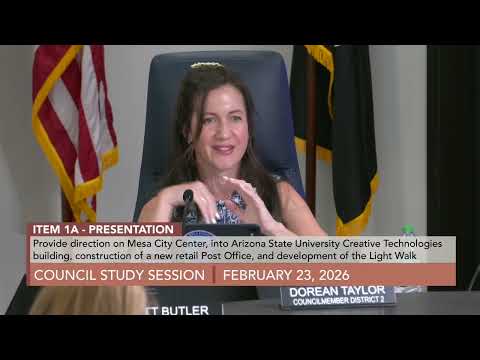
Mesa staff presented a conceptual public‑space project called the Light Walk on Feb. 23, describing a phased pedestrian corridor designed to link downtown civic assets and create programmed nodes for events, public art and evening activation.
Staff said the Light Walk would run from University Drive to Mesa Drive and incorporate shade, misting and night architecture to make the space usable in Arizona’s climate. "The Light Walk concept incorporates natural landscaping and structure to create shade and interest," staff said.
The city commissioned an independent, conservative economic impact analysis. Staff summarized results: using the city's existing annual visitation (roughly 1,000,000 visitors to downtown anchors) and applying a conservative capture rate, the study estimated about 327,000 Light Walk users annually. At a conservative $39 per person for retail and restaurant spending, staff projected roughly $16,000,000 in annual downtown retail/restaurant revenue associated with Light Walk users, supporting an estimated 137 jobs and about $4,800,000 in annual labor income. Over 20 years the study presented $372,000,000 in visitor spending and estimated $7,400,000 in city sales tax revenue (study excluded broader development effects).
Council members asked detailed financial questions about assumptions, per‑visit spending, maintenance costs, and whether Arizona law allows the city to capture increased land value. Staff noted most land along the proposed corridor is city‑owned and that phases could be funded with public and private investment; staff also said they had not done business‑community outreach at the concept stage but planned more robust stakeholder engagement if council advanced the project.
What council asked for: more granular spending and visitor data, a clear maintenance cost estimate and options for private cost participation; several council members asked staff to return with a clearer public‑private funding plan and measurable ROI to justify taxpayer investment.
Ending: Council generally supported the concept direction and asked staff to develop refined financials and engagement plans before committing public funds or final phasing decisions.