Get Full Government Meeting Transcripts, Videos, & Alerts Forever!
Get email alerts on the Mcps Cip Reductions topic
No spam. Unsubscribe anytime.
Montgomery County committee reviews $700M in MCPS non‑recommended CIP cuts, weighs P3 for historic Carver site
Summary
County council committee reviewed MCPS’s two non‑recommended reduction scenarios that would cut roughly $700 million in bonds (scenario A) with an optional FY29 add‑on (scenario B, ~$52 million); school leaders warned nearly two‑thirds of buildings need extensive renovation and described a preliminary $10 million P3 placeholder for the Carver Educational Services Center.
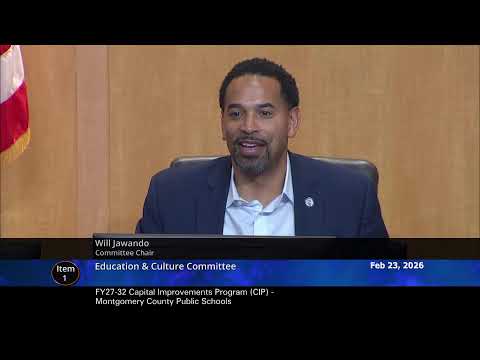
Chair (unnamed) convened the Montgomery County committee on Feb. 23 to continue review of the Montgomery County Public Schools (MCPS) capital improvements program and the school system’s proposed non‑recommended reduction scenarios. Council staff presented a six‑year reconciliation showing large technical and substantive adjustments between the board’s request and the County Executive’s recommendation.
Mister Levchenko, council staff, said the executive’s package included both technical funding changes and substantive cuts: technical funding switches produced roughly $252,000,000 in bond impacts, while the executive’s overall changes compared to the board request amounted to about $809,000,000 over six years, of which he described $557,000,000 as substantive reductions. He summarized MCPS’s options as a cumulative Scenario A (broad six‑year reductions) and Scenario B (additional one‑time reductions in FY29 totaling about $52,000,000) and cautioned that year‑to‑year timing would still fluctuate even if the six‑year totals aligned.
Dr. Taylor, MCPS superintendent, told the committee that “Nearly two thirds of our schools require some type of extensive renovation,” framing the CIP as a decades‑long challenge: even a much larger request would not fully resolve the backlog without additional capacity and planning. She said the system must avoid starting and stopping construction because interrupted projects raise costs and slow delivery.
Andrea Swiatoka, deputy chief of facilities for MCPS, walked the committee through specific project changes in scenario A: removal of Sligo Creek Elementary School and Sligo Middle School from the six‑year plan; reduction of Eastern Middle School’s major capital project to a $131,000,000 scope; maintaining Damascus High School and Eastern Middle School as the top priorities (targeted completions in 2030 and 2031); one‑year delays for some elementary projects (Piney Branch, Burning Tree) and three‑year delays for others (Cold Spring, Highland View); and removal of six‑year expenditures for early childhood centers and holding‑school improvements. Swiatoka said MCPS “are assuming the P3, the public private partnership alternative model” for the Carver Educational Service Center and that the current CIP shows “a $10,000,000 placeholder.” She cautioned that the $10 million is a preliminary best estimate based on other jurisdictions and that the district would first work with an adviser to refine any P3 approach.
Council members repeatedly raised the operating‑versus‑capital tradeoffs: several members noted that delaying capital projects forces recurring operating costs (spot coolers, extra maintenance staff) and can increase total lifetime costs. Council members urged MCPS to produce a longer‑range, public‑facing plan (a 20‑year aspirational roadmap) so residents can see what different investment levels would accomplish and to help the council weigh options such as P3s, scaled ‘refresh’ renovations versus full replacement, and potential changes to building design to reduce long‑term operating costs.
During Q&A, Dr. Taylor said Carver is a historic site and that designation adds complexity but does not preclude P3 structures; she emphasized the need for partner values alignment and said P3s would likely be best suited to sites with potential for a private return (for example, mixed redevelopment that could offset school costs). On early childhood and holding‑school cuts, Dr. Taylor and Swiatoka said removal of the six‑year funding slows but does not end expansion plans and that holding‑school improvements (estimated roughly $10–15 million per site) would be reconsidered if funding allows.
The committee scheduled additional, deeper project review in March (date to be determined) and announced three public education budget forums for community input. The meeting adjourned with staff directed to return with more granular project detail during the next session.
Ending: The committee did not take formal votes on the CIP at this meeting; it advanced a record of the non‑recommended scenarios, set outreach meetings, and scheduled a follow‑up project‑level review in March.