Get Full Government Meeting Transcripts, Videos, & Alerts Forever!
Get email alerts on the Teacher Licensure topic
No spam. Unsubscribe anytime.
Teachers, students and unions urge State Board to keep bachelor's requirement for PE and health licensure
Summary
Students, teachers and union representatives urged the New Hampshire State Board of Education to retain a bachelor'degree requirement in proposed revisions to ED 507.16 for physical education and related health licensure, warning the change risks student safety and lowers professional standards. Board members sought clarifying language about alternative pathways.
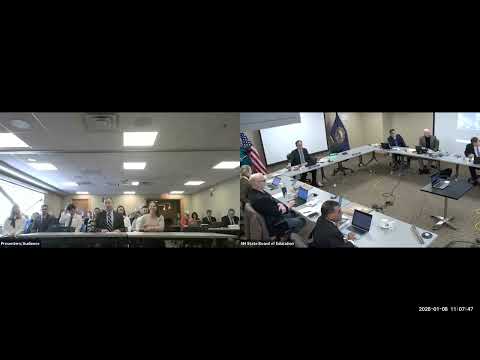
Dozens of students, current teachers and education professionals told the New Hampshire State Board of Education on Jan. 8 that the board should not remove the bachelor'degree requirement from licensure rules for physical education and health teachers.
Jennifer Newick, a senior at Plymouth State University studying physical and health education, told the board she was "worried these changes would make it easier for schools to hire people who are not fully trained to teach physical education or health." Rowan McCarthy and other teacher candidates echoed that concern, saying that short training or experience in recreation settings does not substitute for coursework on child development, injury prevention and differentiated instruction.
The Council for Teacher Education submitted a letter recommending the board retain a bachelor'degree requirement for both endorsements, noting an 11'to'1 vote in favor of that recommendation at its December meeting. Kimberly Organick, speaking for NEA New Hampshire, said a college degree assures districts that educators have the content knowledge and professional training to keep students safe and promote equitable instruction.
Presenters, including veteran teachers and university faculty, raised three consistent objections: first, they said a bachelor'degree signals content and pedagogical preparation, including anatomy, biomechanics, classroom management and special education adaptations; second, they argued that two'year health'science or industry certificates do not prepare candidates to manage large, less'structured physical education classes; and third, they sought clarity about how districts would verify "competency demonstrations" if the degree requirement were removed.
The board and its staff repeatedly clarified that the proposed edits do not eliminate content knowledge requirements in the draft rule and that the change under discussion would remove a general bachelor'degree requirement (a bachelor in any field) rather than reduce required pedagogical standards. "The content knowledge standards are there," the chair said, adding the department would provide the text of the proposed changes in the board packet. Staff and some board members acknowledged potential confusion between the rule text and how it has been described in public testimony, and invited written comments and follow'up questions.
Several speakers cited safety and special education concerns. An associate professor in adapted physical education warned that lowering preparation standards could exacerbate poor outcomes for students with disabilities, and other presenters said poorly trained instructors had led to exclusion or marginalization in some gyms.
The board did not vote on the rule at the Jan. 8 meeting. Members asked staff to collect additional written feedback and to clarify the language around alternative certification pathways and local hiring demonstrations of competency. The department indicated it will accept written submissions and that the board will consider them as part of the ongoing rulemaking record.
What happens next: the record remains open for written comment and the board may schedule further deliberation before any final vote on ED 507.16.