Get Full Government Meeting Transcripts, Videos, & Alerts Forever!
Get email alerts on the Data Center Development topic
No spam. Unsubscribe anytime.
Residents urge Imperial County supervisors to halt AI data center plans, cite water, air and transparency concerns
Summary
Multiple residents and community advocates told the Board of Supervisors they oppose proposed AI/data center projects in Imperial County, questioning developer claims about a $10 billion investment, local job guarantees, environmental review and whether county staff presentations violated open-meeting rules.
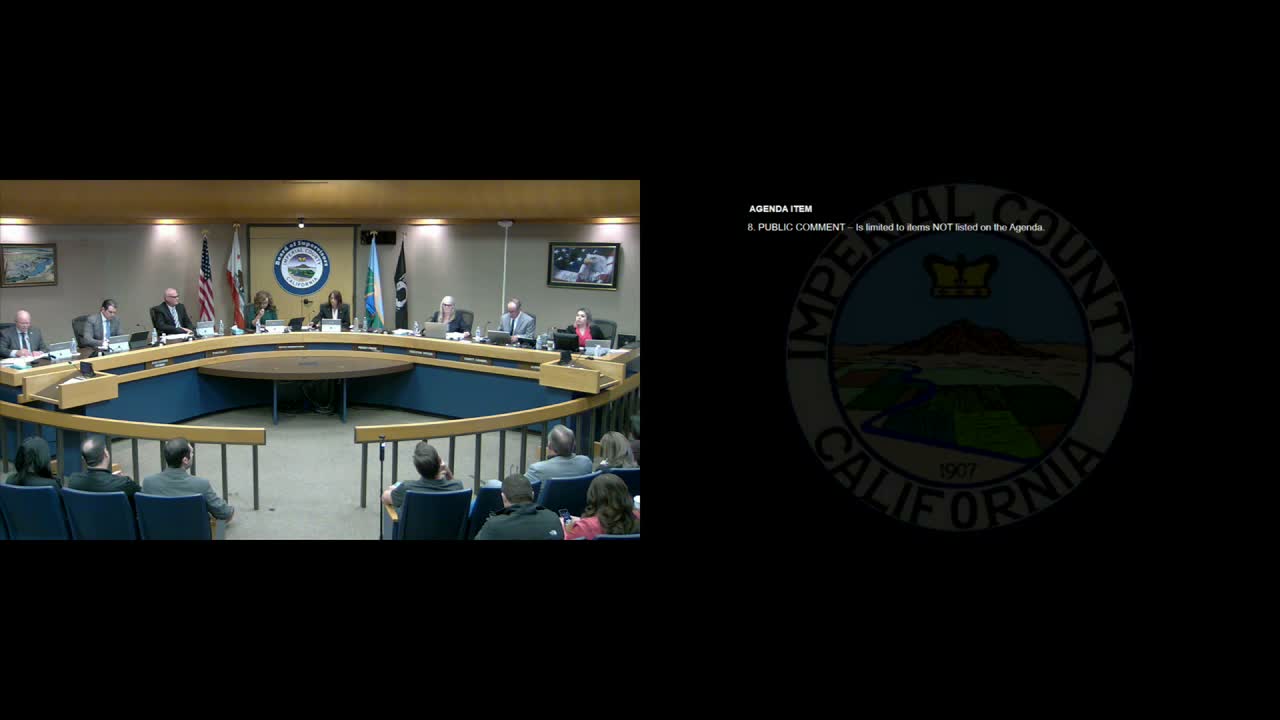
Public comment at the Imperial County Board of Supervisors' Feb. 10 meeting focused heavily on opposition to proposed AI data centers and calls for stronger local oversight.
Peter Rodriguez, a community member who said he attended court proceedings about the project that morning, told the board residents came to defend a style of life "of peace and tranquility" that he said large facilities would threaten. "Keep Imperial Valley the way it is," he said, urging supervisors to listen to constituents who had testified in court.
Several speakers raised the same themes. Francisco Leal questioned the developer's math, disputing a claimed $10,000,000,000 investment on roughly 74 acres and suggesting the numbers supporting one-time and recurring tax revenue are overstated if construction and scale assumptions follow other large data-center projects. "If the tax revenue promise is tied to that $10,000,000,000 investment, we may be looking at only one-third or less of that promised revenue," Leal said.
Jake Tyson pressed the board on process and transparency, saying a recent presentation in the chamber amounted to a policy briefing and advocacy that should have been agendized with backup materials. "Anything less undermines transparency and raises serious Brown Act concerns," Tyson told the board.
Natalia Flores Sanchez urged the board not to treat a workshop as sufficient public review for projects of this scale and raised air-quality and health concerns she said have affected students in the Valley. Laird Stigler and others called for broader public input, including a countywide vote, while Christian Salgado urged the board to adopt a moratorium on new data-center approvals to allow zoning, municipal-code and plan updates.
Board members acknowledged the volume of public comment and the competing interests on the dais. Several supervisors said they wanted to balance economic opportunity and agriculture while ensuring transparency and environmental protections. No formal action on the data-center proposals was taken at the meeting.
The public speakers named specific procedural and analytical gaps they want the county to address: independent estimates of expected construction and tax revenue; full CEQA review and public disclosure of environmental documents; explicit commitments about local hiring and how incentives or exemptions would be administered; and assurance that staff presentations and outside advocacy comply with the Brown Act.
The board also received written comments distributed to members for the record. The matter remains under discussion and, as residents asked, could prompt future hearings or policy changes.