Get Full Government Meeting Transcripts, Videos, & Alerts Forever!
Get email alerts on the Groundwater Management topic
No spam. Unsubscribe anytime.
Butte County updates multi‑million‑dollar groundwater grant work; supervisors press for dry‑well/recharge options
Summary
County staff outlined grant-funded projects (Wyandotte Creek, Vina, Lindo Channel) that fund monitoring wells, data-gap work and periodic evaluations; a supervisor urged exploration of dry wells and other recharge enhancement features.
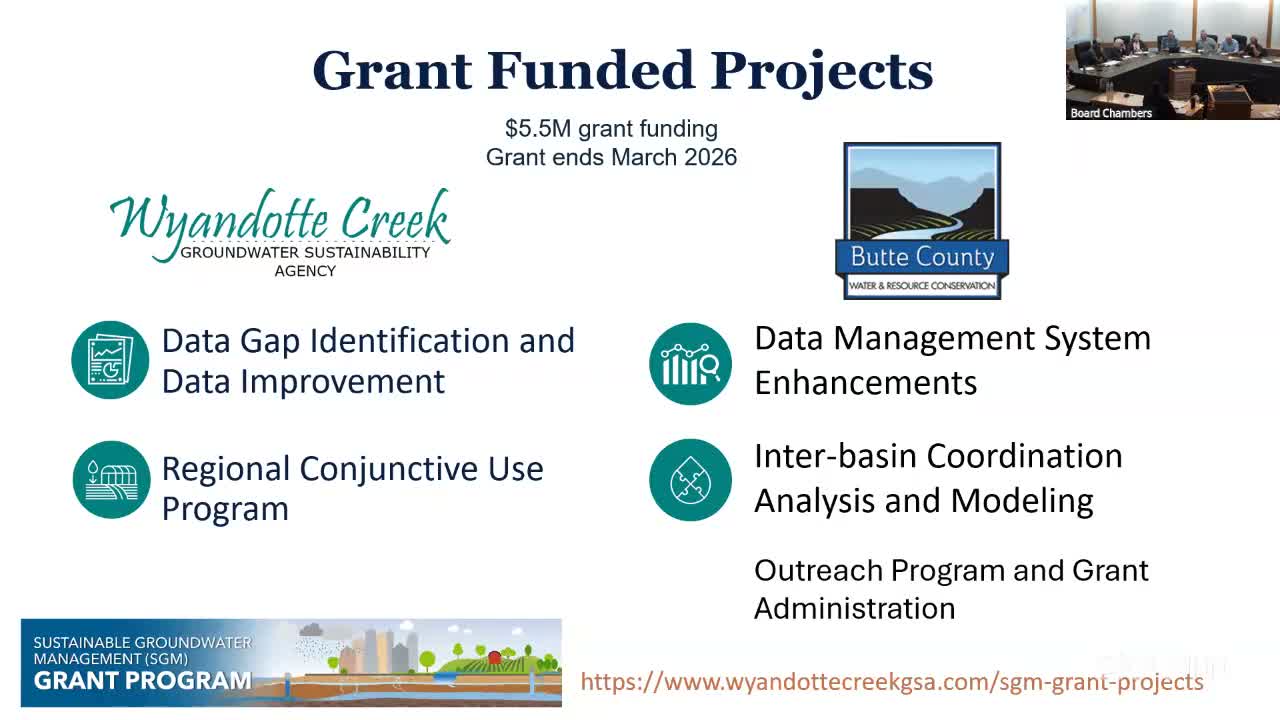
Christina Buck, speaking for the Butte County Water and Resource Conservation Department, briefed the Water Commission on multiple Sustainable Groundwater Management Act (SGMA)-related grant projects that fund monitoring, feasibility studies and plan amendments.
Buck said Wyandotte Creek projects are approaching closeout and that the Wyandotte effort will wrap major work by March 31, 2026, with deliverables feeding a January 2027 periodic evaluation and potential plan amendments. She said the Vina‑led effort (approximately $5,500,000 in grant funding) received an extension to January 2027 to allow new monitoring data from wells to be incorporated into the periodic evaluation documents.
“Those documents will be available to the public,” Buck said, noting monitoring‑well installations, data‑gap work and outreach materials are part of the award packages. Becky Fairbanks and other named project managers will provide project recaps to GSA boards in March and May as those work products close out.
Public comment and technical exchange turned to recharge techniques. Supervisor Todd Kimleshhew asked whether ‘dry wells’ could be used to get excess channel flows into aquifers more efficiently than passive infiltration. Amy Raymond and others described natural areas where surface water “disappears” and cautioned against untested drilling without design. Buck recommended bringing technical expertise back to the commission and referenced “GREFs” (Groundwater Recharge Enhancement Features) as a design category that can be analogous to dry wells depending on construction.
Commissioners encouraged a focused future agenda item: staff suggested contracting or scheduling a presentation by GeoSyntec consultant Joe Turner (already under contract for recharge work) to explain design options, pros and cons, and Central Valley examples.
Next steps: project recaps will be presented to GSA boards in March; staff will arrange a technical briefing on dry wells/GREFs and continue to post project deliverables on county and GSA web pages.