Get Full Government Meeting Transcripts, Videos, & Alerts Forever!
Get email alerts on the Hydrology topic
No spam. Unsubscribe anytime.
Butte County water staff: current water year tracking near average but snowpack remains low
Summary
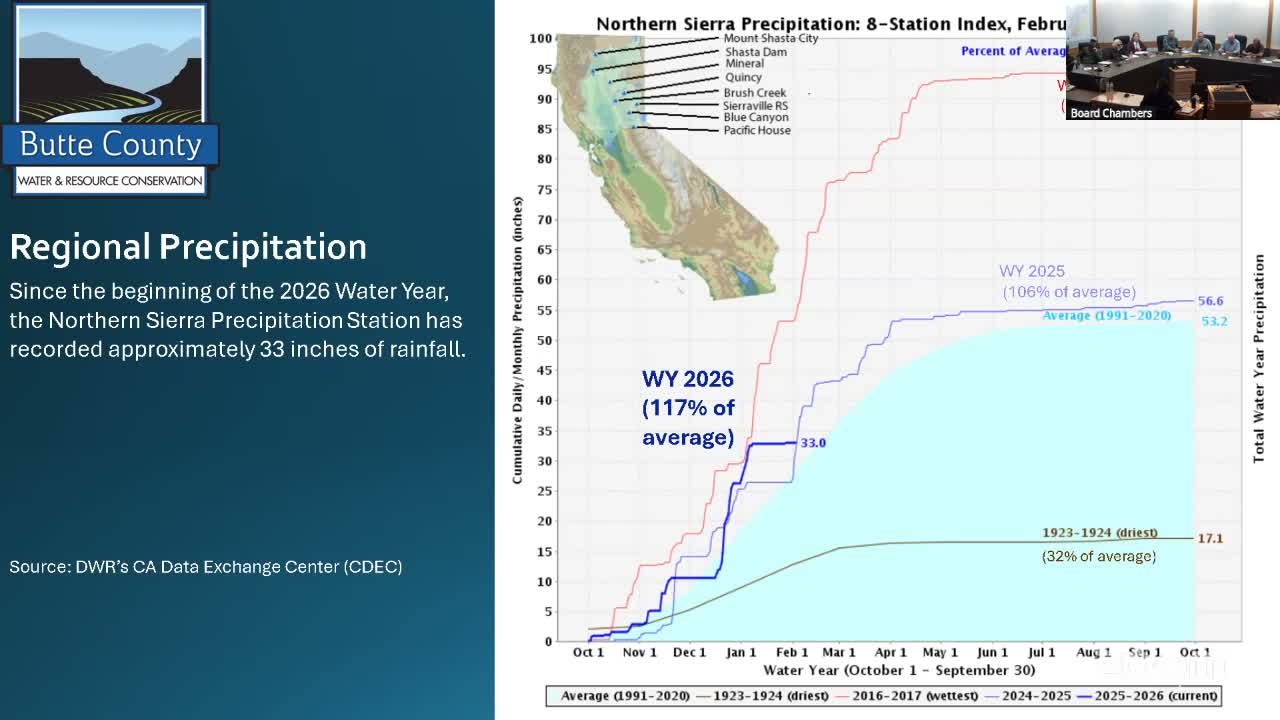
Butte County water staff reported the Northern Sierra precipitation index is slightly above average for the 2026 water year (about 33 inches cumulative), but snowpack is well below normal, limiting runoff and creating uncertainty for late-season reservoir storage.
Kelly Peterson, water resource scientist for the Butte County Water and Resource Conservation Department, told the Water Commission that the current 2026 water year is tracking slightly above average on the Northern Sierra Precipitation 8‑Station Index but that snowpack remains well below normal.
“Right now we’re at 33 inches cumulatively through the water year,” Peterson said during a presentation on regional gauges and local stations. She noted much of that came from a strong December–January rain pulse that was warm and produced little mountain snow, a pattern that leaves runoff and summer reservoir levels uncertain.
Why it matters: snowpack buffers summer water supply because melting snow feeds rivers and reservoirs over the spring and early summer. Peterson said snowpack in the Northern Sierra was about 41% of average for the date and roughly a quarter of the April 1 average benchmark, meaning less natural storage is available from snowmelt than in a typical year.
Peterson described unimpaired-runoff figures and recent state water project decisions that affect local supplies. She said the Department of Water Resources’ allocation recently rose to about 30% — a variable that, along with DWR reservoir operations and low snowpack, complicates forecasts for October 1 storage levels at major reservoirs such as Lake Oroville.
Commissioners and attendees pressed staff on how DWR release decisions and low snowpack change local outcomes. Peterson and panelists emphasized that DWR operation policies and allocation decisions, rather than local rainfall alone, are key determinants of end-of-year storage.
The presentation also covered differences between upper-watershed precipitation (measured by the 8‑station index) and local valley stations — Biggs, for example, stood at roughly 10 inches through January — and highlighted that northern reservoirs were generally above historical averages while pockets of the state remain lower.
Next steps: staff said monthly forecasts through May and the May classification will clarify the water‑year type; commissioners asked the department to return with additional modeling and to discuss implications for groundwater pumping and recharge planning at future meetings.