Get Full Government Meeting Transcripts, Videos, & Alerts Forever!
Get email alerts on the Capital Planning topic
No spam. Unsubscribe anytime.
Committee reviews draft CIP policy, midyear budget and mutual‑aid funds; staff to refine CIP governance and funding percentages
Summary
Committee discussed a draft capital improvement plan policy, recommended adding clearer project narratives and avoiding a Brown Act steering committee; staff also reported a modest midyear budget need and reviewed Bear Valley and Eastern Alpine mutual‑aid fund activity.
The Audit and Finance Committee discussed a draft Capital Improvement Plan (CIP) policy, midyear budget adjustments and mutual‑aid fire funds at its Feb. 10 meeting.
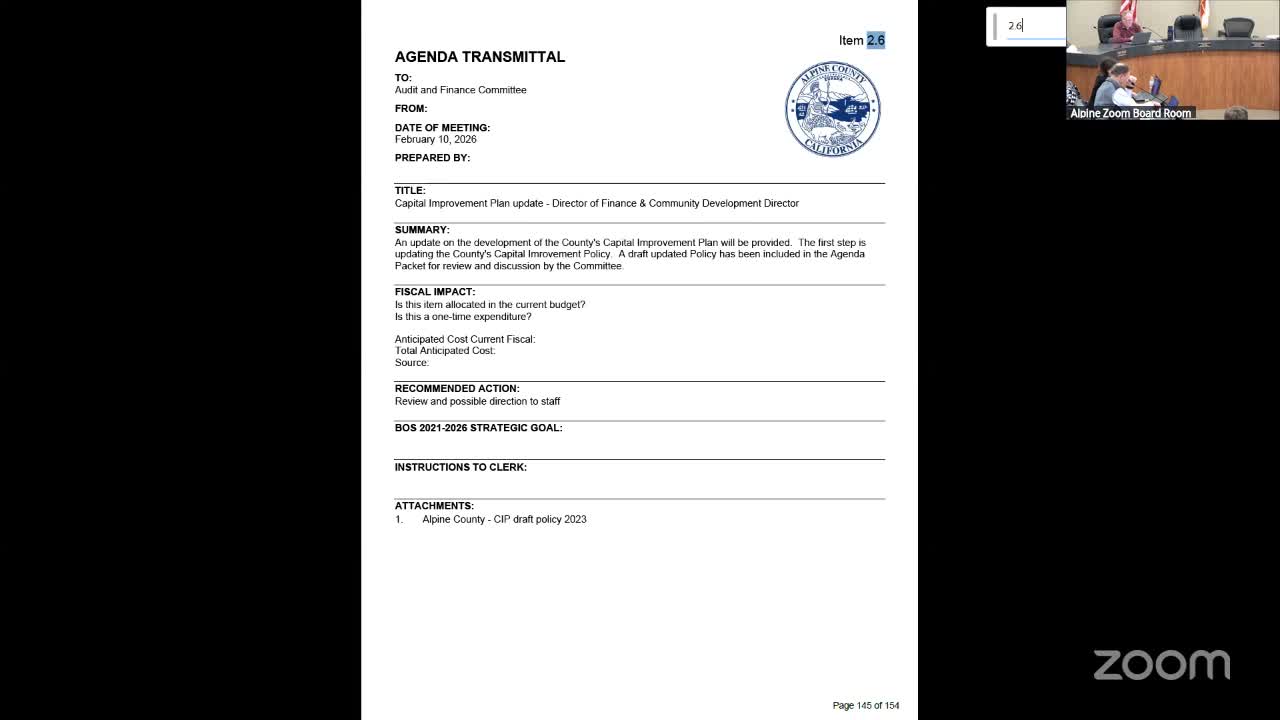
Community Development staff presented a draft five‑year CIP policy that would accept projects generally exceeding $100,000 (with exceptions for IT) and proposed a staff‑level CIP review team including the CEO office, finance and community development. Committee members advised against creating a new Brown Act‑covered steering committee, suggesting instead that community development convene staff as needed and that the audit and finance committee be used for periodic oversight.
Members recommended formatting changes to the draft (move project narratives up front) and proposed linking the CIP to the county's reserve policy by specifying an annual percentage set aside for capital improvements so funds are regularly accumulated rather than spent ad hoc.
On the midyear budget, Director of Budget and Procurement Matthew McSorley said the 2026 midyear is "fairly quiet" but requires about $42,000 of contingency for ambulance contract increases and uncollectible ambulance fees; contingency was increased earlier this year from $300,000 to over $600,000, which McSorley said provides capacity for the adjustment.
Staff also reviewed mutual‑aid activity. Bear Valley's fund is projected to be healthy (about $466,000 after anticipated receivables) and has generated revenue to cover equipment and payroll transfers; Eastern Alpine has a $66,000 shortfall tied to a delayed reimbursable grant and has been less active, raising concerns that changes to FEMA/OES reimbursement rates could reduce future income.
Next steps: staff will revise CIP language (steering committee versus staff convening), consider building a capital reserve target into policy or the reserve policy, finalize midyear adjustments for the Board's Feb. 18 agenda, and continue monitoring mutual‑aid reimbursements.