Get Full Government Meeting Transcripts, Videos, & Alerts Forever!
Get email alerts on the Public Comment Restroom Policy topic
No spam. Unsubscribe anytime.
Multiple residents urge Yavapai County to adopt written restroom policy after disputed police report
Summary
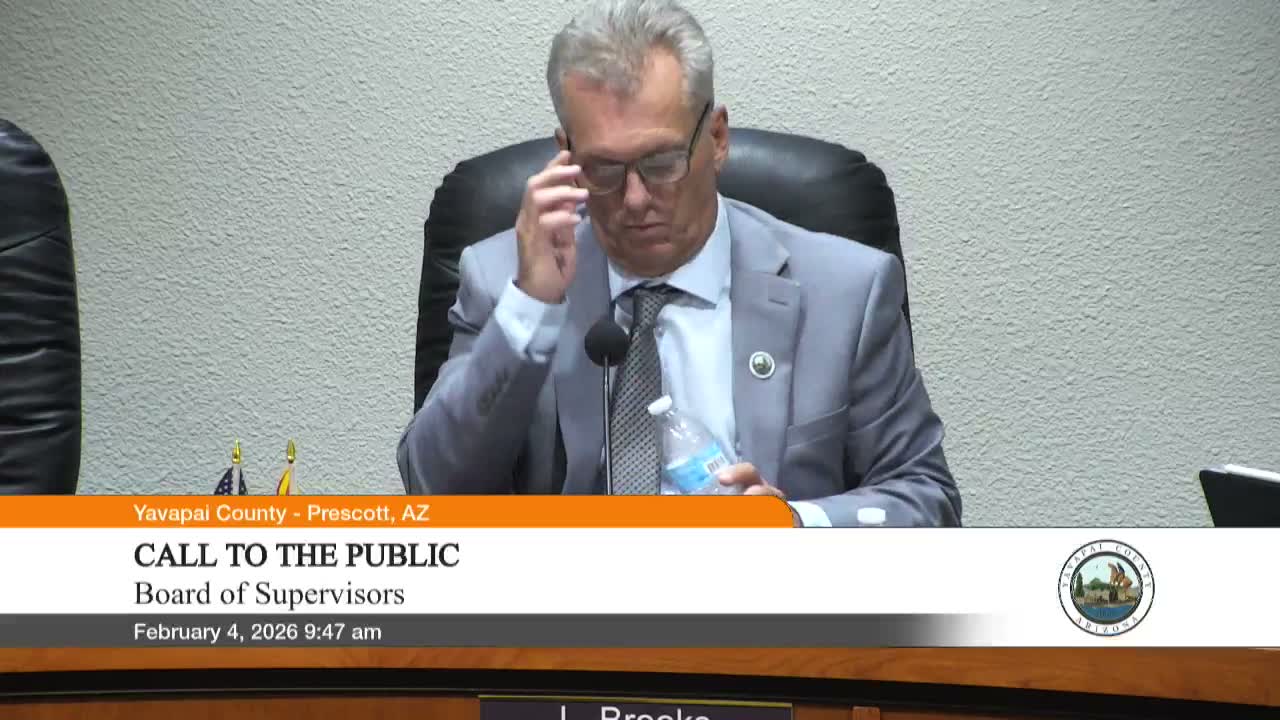
During Feb. 4 public comment, several residents told the Yavapai County Board of Supervisors that a county employee used a women’s restroom and subsequently filed an unfounded assault report; speakers asked the board to institute a written policy restricting restroom access by 'biological men.'
Several residents used the Feb. 4 Yavapai County Board of Supervisors call‑to‑the‑public to demand a written county policy limiting restroom access in county buildings.
William Searle, a downtown Prescott business owner, said a self‑identified transgender county employee entered his store during a crowded fundraising event on Dec. 12 and later filed a police report alleging an assault. "It was a fabrication," Searle told the board, and he said store surveillance footage showed no body check or assault; he said an officer determined the accusation unfounded and issued a trespass order against the employee. Searle asked the board to direct staff to investigate and to adopt a policy that would require men to use men’s restrooms and women to use women’s restrooms in county buildings.
Resident Armati May told the board a verbal allowance for restroom use by transgender employees was communicated in July 2025 and urged the board to instead adopt a written policy prohibiting biological men from entering women’s restrooms. "These concerns are real, and they merit attention rather than dismissal," May said.
Susan Topper recounted that a December police report alleging a body check against her was reviewed and classified as unfounded after officers reviewed video. Topper said she feared retaliation for speaking out and asked for a written policy to prevent biological men from using multi‑stall women’s restrooms in county buildings.
Other commenters framed the issue in public‑safety and moral terms; speakers included Andrew Adams, Morgan Polsky and Ernie Ortega. No formal board action on restroom policy was taken at the meeting. Legal counsel and staff did not present an immediate procedural response during the public‑comment period; board members received the comments but did not schedule a policy vote at that session.
The board did not adopt new restroom rules at the Feb. 4 meeting; staff and the board may follow up as appropriate.