Get Full Government Meeting Transcripts, Videos, & Alerts Forever!
Get email alerts on the Financial Forecast topic
No spam. Unsubscribe anytime.
Consultants warn of declining reserves; council survey stresses fiscal sustainability
Summary
Reftalus presented a 10‑year forecast showing Takoma Park’s unassigned reserves could fall to or below the council’s 17% policy in the early 2030s under current assumptions; consultants demonstrated sensitivity to operating execution, capital timing and borrowing. The community survey (360 respondents) and council survey prioritized fiscal sustainability, housing, and safety.
Takoma Park — Consultants presenting a 10‑year forecast to the City Council said the city’s current fiscal trajectory could push unassigned reserves to or below the council’s 17% policy threshold in the early 2030s unless revenues or spending patterns change.
Mike Burton of Reftalus walked council through an interactive model and stressed conservative assumptions used for the demonstration: general fund operations and maintenance (O&M) execution set at 90% of budget, capital spending at 85% of budget, assessed‑value growth of 4.5% in FY2027 and 3.5% thereafter, and an assumed decline in cable franchise fees. "How much cash are you spending versus how much cash are you taking in?" Burton said, characterizing the cash‑flow framing of the analysis.
Under the status‑quo tax rate of 0.5522 per $100 of assessed value, the model shows reserves declining toward the council’s 17% minimum in FY2030 and dropping below that level thereafter. Alternative scenarios (a reduced tax rate or a constant‑yield adjustment) showed steeper reserve declines unless the city implements compensating measures such as later tax increases, lower O&M execution, lower capital outlays, or additional revenue sources.
Council members probed the model’s sensitivity. Consultants demonstrated that modest reductions in O&M execution (the percent of budget actually spent) or delaying specific capital projects meaningfully improved reserve trajectories. They also ran a hypothetical borrowing scenario (a $17 million recreational facility financed over 30 years at 6% as an example) and showed the resulting debt service would materially depress reserves in later years.
The consultant team and city staff emphasized that the model is a decision‑support tool to inform budget choices and that staff will continue working with the consultants to refine assumptions and test council‑requested scenarios. The consultants said they will return early next year with a final forecast and scenarios.
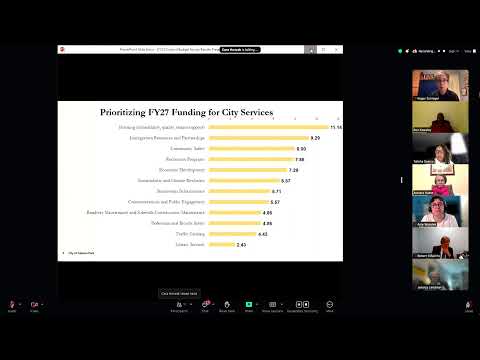
Community and council survey results: Budget manager Ron Kewaly reported 360 community respondents. Top community priorities included retention of affordable housing, traffic/pedestrian/bicycle safety improvements, and sustainability/green energy; 55% of community respondents preferred maintaining city services at current levels to balance the FY27 budget while only 11% supported increasing property taxes. The council’s internal survey (seven members) prioritized housing, immigration resources, and community safety and largely recommended maintaining current revenue settings while exploring alternate funding sources.
What happens next: Staff will work with Reftalus to run follow‑up scenarios requested by council, produce a final forecast in early 2026, and use community and council input to inform FY27 budget development.