Get Full Government Meeting Transcripts, Videos, & Alerts Forever!
Get email alerts on the Housing Policy topic
No spam. Unsubscribe anytime.
Connecticut leaders unveil bipartisan housing growth bill, call for special-session vote
Summary
State and municipal leaders announced a bipartisan "housing growth" bill that pairs regional housing needs assessments, infrastructure support and incentives to convert underused commercial sites into homes; officials said the measure will be released ahead of a special session for a Wednesday vote.
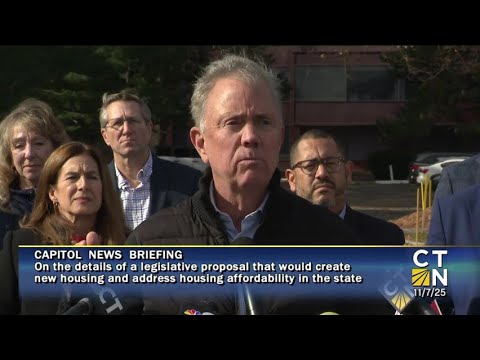
Selah Musquera Bruno, commissioner for the Connecticut Department of Housing, opened a news event announcing a bipartisan housing growth bill crafted with legislators, the governor, municipalities and housing advocates. "This bill...has been the result of collaboration among legislators, our governor, lieutenant governor, our municipalities, and also, housing advocates," Bruno said.
The package, officials said, combines statewide goals with local flexibility. Majority Leader Jason Rojas described the measure as the product of compromise after difficult talks and framed it as focused on three goals: supporting families and individuals, growing the economy and strengthening communities. "Failure is not an option," Rojas said of efforts to address the housing shortage.
Gov. Lamont said the administration will release the bill text "within hours" and requested lawmakers convene a special session to consider it. He outlined several implementation priorities: encouraging conversion of underused commercial parcels and surface parking into housing, partnering with towns to accelerate sewer and water projects, and supporting transit-oriented development. "If you're gonna build, that housing down there, we'll be there to speed up and get more regular rail service," Lamont said, adding the state would help towns "rebuild your train stations" to support denser, transit-linked housing.
The bill creates a stronger role for regional councils of governments (COGs). Matt Hart, executive director of the Capital Region COGs, said the nine regional COGs will work with the Office of Policy and Management and municipalities to carry out regional housing needs assessments and set realistic, locally informed targets. Officials said those assessments will inform allocations to towns so numeric targets are not imposed without local input.
Officials highlighted specific programmatic context and numbers. Lt. Gov. Susan Bysiewicz said about 7,000 housing units are currently under construction in the state and cited the administration's Time to Own program, which the lieutenant governor said helped roughly 7,400 first-time buyers. Advocate Pete Harrison cited a poll he referenced showing "90% of people in Connecticut do not think we're doing enough on affordable housing."
Municipal leaders at the event praised the collaborative process. CCM board president Mayor Laura Hordick said the revised approach addressed long-standing statutory and administrative barriers and was the result of listening to local concerns. Selectmen and mayors from urban, suburban and rural towns described tools their communities have used—such as inclusionary zoning, density bonuses and tax incentives—and said the bill could help move projects that are already prepared for development.
Housing-service providers also urged urgency. Cara Capone, CEO of Community Housing Advocates, described people she serves who are priced out or facing homelessness and said the organization supports measures that speed housing into service quickly. "All we deal with on a day to day basis is seeing women and children coming in who cannot afford a place to live," Capone said.
Officials acknowledged that some numeric targets were softened from earlier versions after the governor paused the original bill to consult municipal leaders. They emphasized that numeric allocations will follow regional assessments and local conversations, not a one‑size‑fits‑all mandate. The administration said the bill will include special provisions to ease parking requirements for small projects (units under 16), while preserving some local discretion, and to speed commercial-to-residential conversions.
No formal vote occurred at the announcement. The next procedural step, officials said, is the release of the bill text and consideration at a special legislative session expected Wednesday. Sponsors asked lawmakers to review the text when it is released and prepare for the special session vote.
Supporters framed the measure as one step in a longer effort to address a multi-decade housing shortfall; they said additional work will continue after the special session to refine implementation and tackle remaining obstacles such as sewer capacity and funding for infrastructure improvements.