Committee rejects bill to let Self‑Defense Act permit holders carry concealed weapons in Oklahoma Capitol
Loading...
Summary
A House committee voted 4–5 to defeat House Bill 3,094 after the Department of Public Safety warned the change would create safety and manpower challenges; sponsor Representative Jenkins argued SDA permit holders are vetted and would be legitimate, low‑risk visitors.
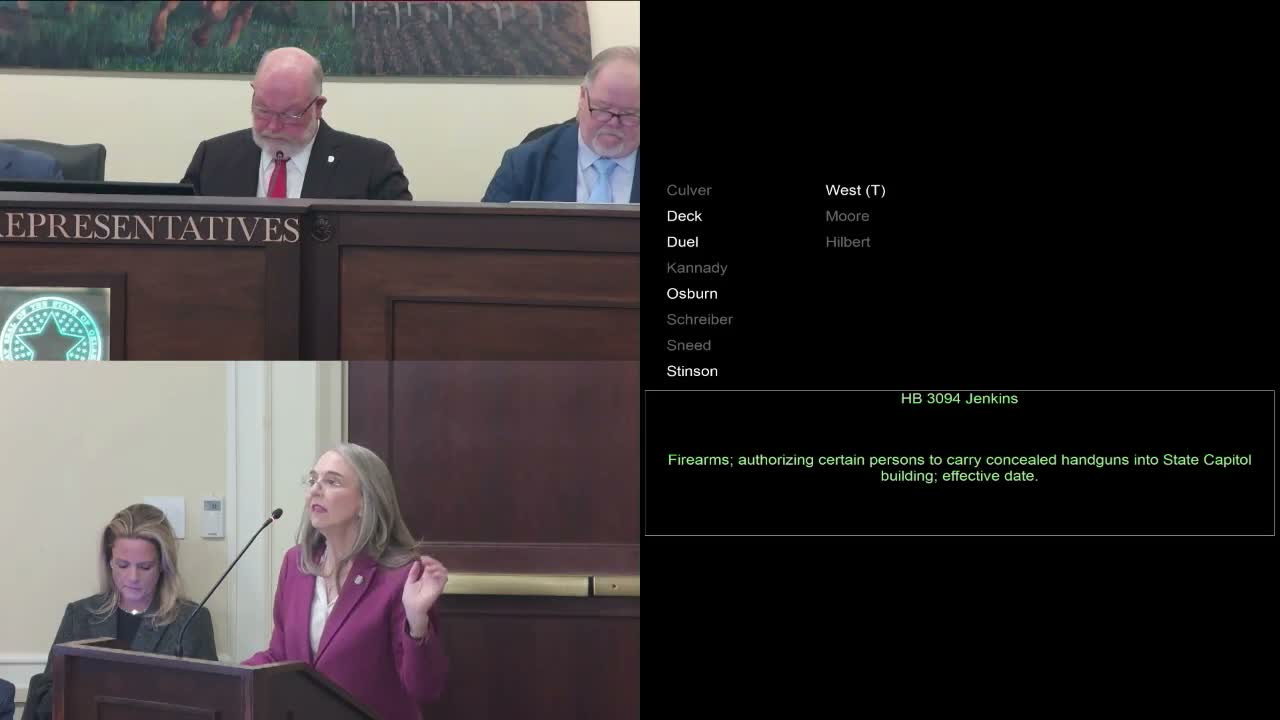
A House committee on Feb. 25 rejected House Bill 3,094, which would have allowed people holding Self‑Defense Act (SDA) permit cards to carry concealed firearms inside the Oklahoma Capitol. The bill failed on a recorded vote, 4–5.
Representative Jenkins, the bill’s sponsor, said the measure was intended to allow vetted constituents to carry inside “the people’s house.” Jenkins told the committee that SDA cardholders undergo background checks with the local sheriff and the Oklahoma State Bureau of Investigation, submit fingerprints to the FBI and complete training; “an American and Oklahoman should never have to relinquish their second amendment right at the Capitol door,” Jenkins said.
The Department of Public Safety’s director, who testified at the committee’s request, said the agency had only recently been made aware of the legislation and raised security concerns. The director warned that if many people carried inside the building, officers could have difficulty distinguishing lawful carriers from an active attacker and that a full threat assessment would be necessary to estimate additional trooper staffing and costs. “If a gunfire started inside of this building, our ability to recognize who are the good actors and who are the bad actors…is very concerning to us,” he said.
Committee members pressed both the sponsor and DPS on operational issues. Representative Deck, among others, asked how the checkpoint process would change, whether a database would be required to track regular carriers, and whether security staff would need extra manpower. Jenkins said security officers would simply verify a valid SDA card at the checkpoint, and that the sponsor believed no additional funding would be required. DPS staff answered that checks beyond visual inspection—such as NCIC queries to confirm a permit remains valid—might be needed and that maintaining a database would create costs and manpower burdens.
Members debated the bill’s scope and drafting approach. Some lawmakers argued the statute should explicitly list places where carrying is prohibited rather than create a permissive carve‑out for the Capitol; others emphasized the bill’s stated starting point limited the change to SDA cardholders. Questions also ranged from whether the Capitol is effectively a “gun‑free zone” given law‑enforcement personnel who carry, to whether the bill’s focus addressed parking‑lot safety for constituents arriving after dark.
Representative Jenkins framed the measure as a safety provision for everyday constituents—giving the example of a working mother who might otherwise leave a firearm unsecured in her vehicle and then walk to the building unarmed. Critics said the bill would complicate security for legislative staff and Capitol Police and could increase response requirements for DPS.
After discussion, the committee called the recorded vote. The chair announced the tally as 4 ayes and 5 nays, and the motion to pass failed. The bill’s sponsor thanked committee members for the opportunity to present and said he would continue to engage colleagues on the issue.
What happens next: Because the committee rejected the motion to pass, the bill will not advance from this committee in its current form. The sponsor indicated a willingness to consider alternative drafts or narrower approaches in future sessions.