
Senate Judiciary Reviews S.222, a Proposal to Bar Businesses from Election Spending in Vermont
Get AI-powered insights, summaries, and transcripts
Subscribe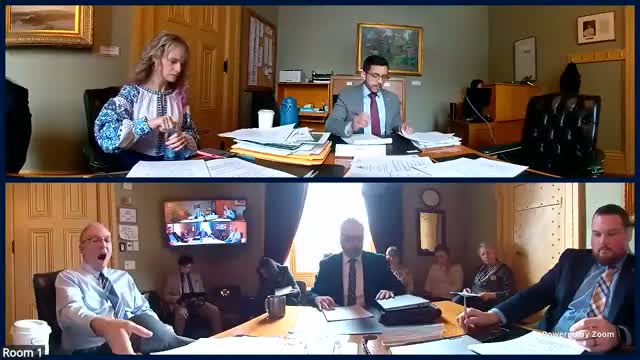
Summary
Legislative Council told the Senate Judiciary Committee that S.222 would strip statutory authority for business entities to spend on election or ballot-question activity, but counsel and legislative attorneys warned of substantial First Amendment, Contracts Clause and due-process issues and recommended further hearings.
Rick Seibel of the Office of Legislative Council told the Senate Judiciary Committee on Feb. 24 that S.222 "would basically remove the power of not just corporations but business organizations in the state from spending money in election activities." Seibel asked the panel to treat the session as an initial walkthrough because the bill spans 36 pages of repetitive statutory edits across Vermont’s business codes.
The bill would amend multiple titles that govern corporations, cooperatives, limited liability companies, partnerships and nonprofits. Under the draft language cited by Seibel, businesses would have only those "artificial person powers" necessary for lawful business and expressly would have "no power to engage in election activity or ballot issue activity," with any such activity declared "ultra vires and void." Seibel explained that "value of activity" is defined to include paying, contributing, spending money or providing anything of value to support or oppose candidates or ballot measures, while preserving narrow exemptions for bona fide independent news reporting, commentary or editorial content and for lobbying activity before a legislative body.
Committee members pressed for practical clarifications. One asked whether a commercial print shop fulfilling an order for campaign postcards could be treated as providing impermissible corporate election activity; Seibel said that possibility exists under the draft and that an entity could decline the business. The bill also gives the secretary of state broad rulemaking authority to define terms such as what counts as "de minimis" corporate use in communications, and committee members queried whether those rules could establish timing parameters tied to election calendars.
On enforcement, the draft replaces standard broad entity powers in some statutes with conditional grants of legal status and adds penalties. Seibel read a provision applying to limited liability companies that would require an LLC that "undertakes, finances or directs election activity" without authority to remit payment to the office of the state treasurer equal to the value expended. A senator asked whether a 100% penalty has precedent; Seibel said he had not seen identical language and would research precedent.
Seibel also described reach to out-of-state entities: a foreign (out-of-state) LLC that directly or indirectly finances or directs election activity in Vermont would be "conclusively deemed" to be transacting business in the state for jurisdiction and enforcement purposes. Several members raised concerns about personal-jurisdiction and indirect participation through multiple states.
Legislative counsel Tucker Anderson summarized the litigation and constitutional backdrop. Anderson cited a lineage of U.S. Supreme Court decisions recognizing some corporate rights dating to 19th-century railroad tax cases, the 1978 First National Bank of Boston v. Bellotti decision, and Citizens United. Anderson noted the analysis must also account for the Vermont Constitution — specifically Section 69 — which limits the legislature's exercise of power over corporations in ways that factor into the bill's legal assessment.
Seibel and counsel told the committee the proposal is novel: "No state has actually enacted language like this," Seibel said, and they urged the committee to hear witnesses and allow more time for research on potential First Amendment, Contracts Clause, due-process and other federal constitutional issues. The bill contains transition language that would preserve contracts and legal obligations entered on or before Dec. 31, 2026, and would take effect on Jan. 1, 2027. The chair ended the meeting at noon after the overview and asked staff to schedule follow-up hearings for deeper review and witness testimony.
No formal vote or motion was recorded at the Feb. 24 session; lawmakers asked Legislative Council and counsel for more detailed legal analysis and precedents before the committee proceeds further.