Revenue report: Minnesota estimated market value rose 3.7% in 2025; 2023 showed an exceptional ag‑land spike
Loading...
Summary
The Department of Revenue presented its annual assessment practices report showing statewide estimated market value (EMV) rose 3.7% for 2025, with notable 2023 agricultural land increases, metro apartment declines in 2024–25 and shifting tax base effects from homestead exclusions and deferrals.
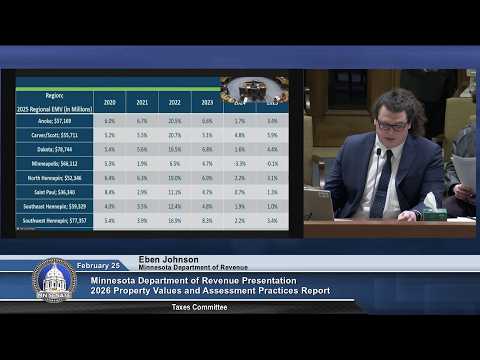
Evan Johnson, a state program administrator at the Minnesota Department of Revenue, presented the department’s property values and assessment practices report, which uses county PRISM submissions to summarize 2025 assessment‑year trends for taxes payable in 2026. Johnson emphasized the report is descriptive—the agency compiles estimated market values (EMV) set by assessors—but does not ascribe causality for observed changes.
The report’s headline figure: total statewide EMV increased by about 3.7% in 2025, roughly matching 2024. Johnson noted an exceptional spike in agricultural land values during 2023—the largest increase in the dataset going back to 2005—and said increases in 2024 and 2025 were smaller by comparison. He described a set of property categories the report tracks (agricultural and rural vacant land; apartments; residential 1–3 units; seasonal residential recreational properties; commercial; and industrial) and explained the department also reports a "constant class EMV" that excludes new construction and classification changes to isolate static appreciation.
Key findings and figures Johnson highlighted include:
- Agricultural land saw a very large increase in 2023 and smaller increases or modest declines in specific regions in 2025. Johnson noted over 96% of agricultural EMV is in Greater Minnesota VOS regions.
- Apartment values, particularly in metro areas, rose rapidly through 2023 but fell in 2024 and 2025; when excluding new construction, apartment constant class EMV declined in every metro region.
- Commercial property EMV decreased statewide by about 2.6% in 2025; that decline was split among regions rather than concentrated in one place.
- The homestead market value exclusion formula was expanded in 2024 to a maximum of $38,000; Johnson said roughly $24.4 billion was excluded statewide in 2025 under that program.
- Green Acres (an agricultural deferral program) saw enrolled acres fall since 2020 and the percent of value deferred has generally hovered in the mid‑to‑high teens, with a 2022 high near 21%.
Committee members asked whether the report explains why specific changes occurred. Johnson repeated the report’s descriptive scope and said assessors set EMV on Jan. 2 of each assessment year using sales studies from the prior period; members suggested factors such as low mortgage rates during the pandemic, remote‑work patterns and regional events could influence demand and valuations. Joanna Behrs, legislative director at the Department of Revenue, said the department uses report data to identify trends and recommend policy responses to legislators when needed.
Johnson said the report contains regional breakdowns, constant‑class comparisons to isolate new construction effects, and that the full report and historical data are available on the Department of Revenue website. The committee took no formal action on the report; members discussed using the analysis when evaluating proposals that would change classification rates or tax policy.