Lifetime Citizen Portal Access — AI Briefings, Alerts & Unlimited Follows
Meteorologists Describe How Forecasts and Portable Weather Stations Support Firefighter Safety
Loading...
Summary
At an incident briefing, a National Weather Service meteorologist and Australian meteorologist Alex Militsas outlined how real-time observations, portable solar-powered weather stations and high-resolution models inform tactical decisions such as burnouts and protect crews.
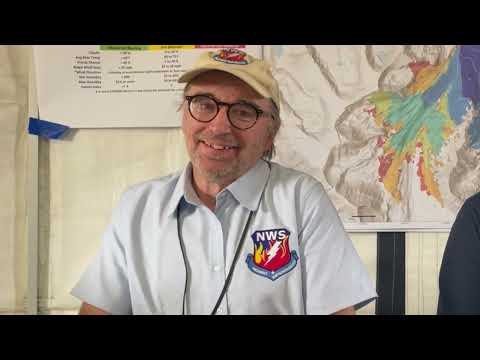
An unnamed National Weather Service meteorologist and Australian meteorologist Alex Militsas described how forecasts and portable weather stations feed operational decisions that affect firefighter safety.
The unnamed NWS meteorologist said weather is "a chart of a sort of a 3 legged stool that fire behavior relies on," naming weather, terrain/topography and fuel conditions as the three main factors. He said his primary role on an incident is "firefighter safety," answering questions from the incident management team and line operators about conditions for tactical actions such as planned burnouts — for example, whether winds and humidity are favorable.
Militsas, with the Australian Government's Bureau of Meteorology, said he is supporting operations at the National Interagency Fire Center (NIFC) for about a month and that he had come to observe a U.S. incident camp. He noted the U.S. practice of embedding a meteorologist in the incident management team is uncommon in Australia and called the U.S. operations "a lot bigger than anything I've seen in Australia." He said Australia uses similar technology for monitoring and forecasting but "we don't often do that in Australia, so that's been really amazing."
The NWS meteorologist outlined how portable weather stations are used in the field: crews can deploy solar-powered units that transmit temperature, relative humidity and wind observations by satellite, allowing incident meteorologists to retrieve near real-time data when Internet access is available. He said the Bureau of Land Management developed the portable station concept in the early 1980s and that, by the turn of the century, satellite transmitters enabled automatic hourly retrieval of that data.
He added that when a portable station is within line of sight, a division supervisor or crew boss can trigger the unit to broadcast current conditions on their radio frequency so field supervisors know "exactly right now" what the temperature, relative humidity and winds are at that station.
Both meteorologists said they use near-real-time satellite imagery, radar and high-resolution weather modeling to identify and time thunderstorms and rainfall, and consult longer-range models to project conditions over the coming week to help anticipate how a fire might evolve.
The meteorologist also described a long-standing exchange program in which U.S. firefighters travel to Australia during the U.S. winter and Australian crews assist in the U.S. summer, noting it as a source of mutual support and experience-sharing.
The speakers emphasized continuous monitoring and forecast updates as central to tactical decisions and crew safety on active incidents.