Get Full Government Meeting Transcripts, Videos, & Alerts Forever!
Get email alerts on the Workday Settlement topic
No spam. Unsubscribe anytime.
Oregon settles Workday class action for $15 million; DAS outlines biweekly pay, $1,700 transition payment and 40 hours leave
Summary
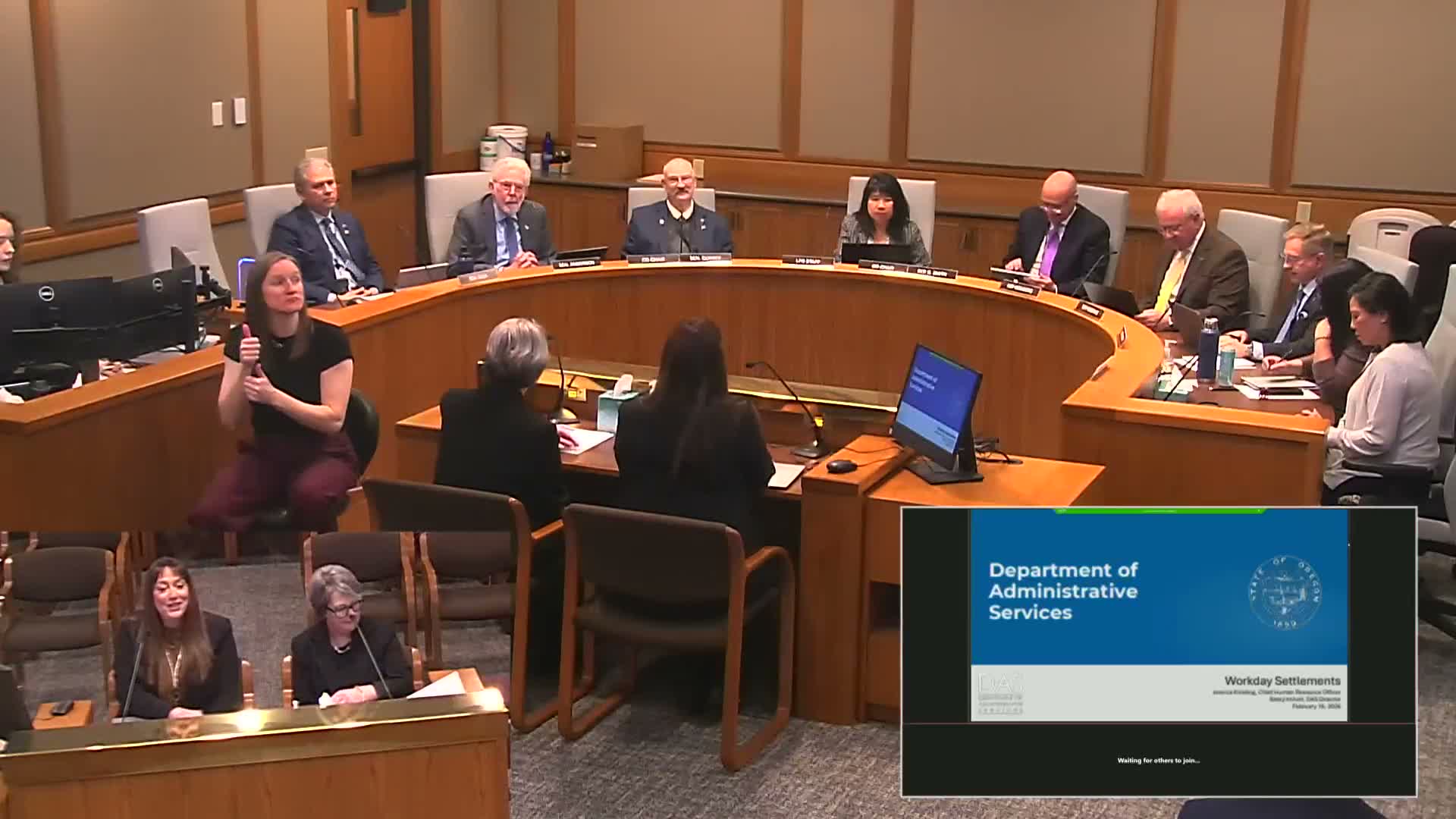
At a Feb. 16 Ways and Means subcommittee briefing, the Department of Administrative Services said a $15,000,000 class-action settlement tied to the 2022 Workday payroll rollout covered more than 60,000 class members and that the state will move employees to biweekly pay with one-time $1,700 transition payments and 40 hours of paid leave at implementation (targeted July 1, 2027).
The Department of Administrative Services told the Ways and Means joint general government subcommittee on Feb. 16 that the state resolved a class-action suit tied to the 2022 Workday payroll rollout with a $15,000,000 settlement and is negotiating and implementing related grievance agreements that change pay practices.
"Ultimately, when we settled, we settled for a total of $15,000,000," Jessica Neehling, the state's chief human resources officer, told the committee, adding that the settlement covered more than 60,000 class members and that named plaintiffs received $7,500 apiece. An outside administrator, Rust Consulting, issued the class checks in December 2025, Neehling said.
The settlement and subsequent grievance agreements require the state to change pay structure to address implementation problems. Betsy Eimholt, director of the Department of Administrative Services, said the three structural changes negotiated with labor partners are moving from monthly to biweekly pay, converting overtime-eligible salary employees to hourly pay, and ending the use of forecasting in payroll calculations. Those changes must be implemented on or before July 1, 2027, the presenters said.
Under the negotiated terms, employees will receive a one-time transition payment of $1,700 when the new pay schedule goes into effect and 40 hours of paid leave that may be banked or cashed out at the employee's election. Neehling said most represented unions agreed to bargain over the structural changes for their 2025–27 collective-bargaining agreements and that management and unrepresented employees at salary range 30 or below in the executive branch will receive an equivalent transition payment; those at range 31 and above will not.
On funding, Neehling told the committee the $15 million class settlement already was paid and booked in 2025. She said the transition-payment costs are expected to be booked in the 2025–27 biennium and handled at the agency level, with the CFO's office and the legislative fiscal office reconciling budget treatment. "The costing has been looked at," she said, but final budget treatment will follow standard reconciliation and agency booking processes.
DAS officials said advisory committees with labor partners will advise implementation details such as leave accruals and that final fiscal impacts of the 40-hour leave (how many employees cash out versus bank it) cannot be known until employees make those elections.
The presenters said court approval was required for the class settlement; the class settlement on the class piece was finalized in March 2025 after prior contingency conditions were met. DAS will provide periodic updates to the committee as the state moves through implementation planning and execution phases toward the scheduled 07/01/2027 go-live.
The committee did not take formal action during the briefing; DAS representatives said they would follow up with detailed fiscal information on agency cash-flow impacts when available.