
Opelika council approves Faith Technologies development agreement and tax abatements amid resident protests over transparency
Get AI-powered insights, summaries, and transcripts
Subscribe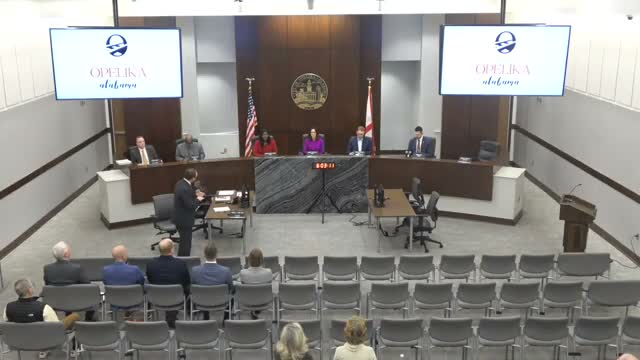
Summary
The Opelika City Council approved a project development agreement and tax abatements for Faith Technologies Inc., citing a minimum $72 million investment and about 200 jobs; residents voiced concern the packet lacked an executive summary and repeatedly asked whether the site would be a data center.
The Opelika City Council approved on a special-call meeting a project development agreement and associated tax abatements for Faith Technologies Incorporated after more than an hour of public comment focused on transparency and whether the site would host a data center.
John Sweatman, director of economic development for the City of Opelika, told the council that Faith Technologies is not a data center but a manufacturing operation that will assemble electrical components for clients including hospitals and businesses that maintain backup power systems. Sweatman said the company’s investment and hiring timeline required an expedited vote so equipment arriving on site would qualify for state-authorized abatements.
In public comment, residents repeatedly said the agenda packet was posted late and lacked a concise executive summary explaining why the city would provide roughly $600,000 in incentives. “If I was responsible for calling a meeting of this size, $600,000 in budget, I’d be mortified if this was the information I put together for public comment,” said Jason Lance of North 9th Street.
Matt Rabine, real estate development manager for Faith Technologies (FTI), said the company expects to invest at least $72,000,000 and create about 200 jobs with an average salary near $65,000. He described the proposed use as assembly and manufacture of electrical assemblies and modular systems and reiterated the site does not and will not have capacity for a data center. “We are not a data center,” Rabine said. “We’re not working toward being a data center.”
Several speakers raised environmental and health concerns tied to high-power data centers, including particulate pollution from power generation and backup generators. “AI data centers need massive amounts of power… long-term exposure to fine particulate matter is directly linked to numerous negative health outcomes,” said Dustin Howard, who presented epidemiological context and urged the council to adopt preventive measures.
Council members asked about possible NDAs, the statutory process for abatements and the local fiscal impact. Sweatman explained that state law governs which firms qualify for certain abatements, that the city processes applications and forwards them to state agencies, and that some local incentives are performance-based reimbursements. He said portions of taxes earmarked for schools, hospitals and dependent children services are not abatable by state law and therefore would continue to receive funds.
After council discussion and staff answers, a motion to approve the project development agreement passed on a roll-call vote; the transcript records ayes from the council and notes the agreement was approved. The council then voted to approve the related tax abatements and exemptions; the transcript records unanimous ayes and the abatements were approved.
Residents who addressed the council after the votes reiterated that the process could have been handled with broader advance notice and clearer public materials. Morgan Carpenter said the confusion “could have been avoided if we’d had more transparency.” The meeting ended after a motion to adjourn.
Votes at a glance - Project development agreement with Faith Technologies Incorporated — approved (roll-call, all recorded ayes). - Tax abatements and exemptions for Faith Technologies — approved (roll-call, all recorded ayes).
What’s next City staff indicated the state agency review remains part of the statutory abatement process; equipment arriving before final state ratification could affect qualification for abatements, which the economic development director cited as the reason for the special meeting.
Sources and attributions Quotes and figures in this report come from public remarks and staff comments on the record at the Opelika City Council special meeting regarding Faith Technologies Incorporated.