Get Full Government Meeting Transcripts, Videos, & Alerts Forever!
Get email alerts on the Water Quality Funding topic
No spam. Unsubscribe anytime.
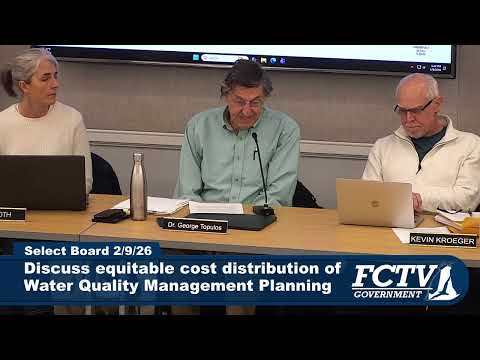
Falmouth leaders call for committee to design fair financing for mandated water-quality work
Summary
At a joint meeting, the Board of Health urged the Select Board to form a committee to develop an equitable plan for paying for state-mandated sewer and denitrifying septic projects that could cost the town over $1 billion in coming decades.
The Falmouth Board of Health urged the Select Board on Thursday to form a committee to design a fair way to share the costs of state-mandated water-quality improvements, saying the town faces very large capital needs that will be borne unevenly by homeowners.
“Falmouth is gonna be implementing the water quality mitigation projects that the Commonwealth mandated… The comprehensive set of costs related to all those watershed plans is likely to be more than 1000000000 dollars,” a board member said, summarizing the scale of the town’s expected fiscal exposure. Board members described a mix of large projects — sewers, a new outflow pipe, wastewater treatment and thousands of denitrifying innovative-alternative (IA) septic systems — that will be phased over years.
Why it matters: Board members and Select Board representatives said the distribution of those costs could leave some homeowners paying vastly more than others depending on whether they must connect to sewers, install IA systems or need no work. Several speakers warned that uneven burdens could erode public support for the overall watershed plans and urged early, transparent design of financing so residents and the town can plan.
Board of Health members proposed an advisory or standing committee that would include people with finance and nitrogen-management expertise, town finance staff and water-quality specialists. Select Board members responded positively, but members debated whether to form a short-term working group (to move quickly) or a public standing committee with recorded meetings and minutes.
State role and funding: Several participants urged outreach to the state delegation and noted that some state grant programs and an environmental bond bill might offer support, but agreed the town should not wait for Beacon Hill. The wastewater superintendent reminded the board that achieving and documenting flow-control rules (the town’s “flow-neutral” bylaw) is tied to access to low-interest SRF loans.
Next steps: Select Board members asked town staff to draft scope and membership for the committee. The Board of Health also asked the Water Quality Management Committee to continue pressing the issue and promised the Board of Health would participate when asked.
The boards did not adopt a financing plan on Thursday; they agreed to develop a committee charge and return with more concrete membership and timelines.