
DEQ describes long timeline, rising costs and community steps for Portland Harbor Superfund cleanup
Get AI-powered insights, summaries, and transcripts
Subscribe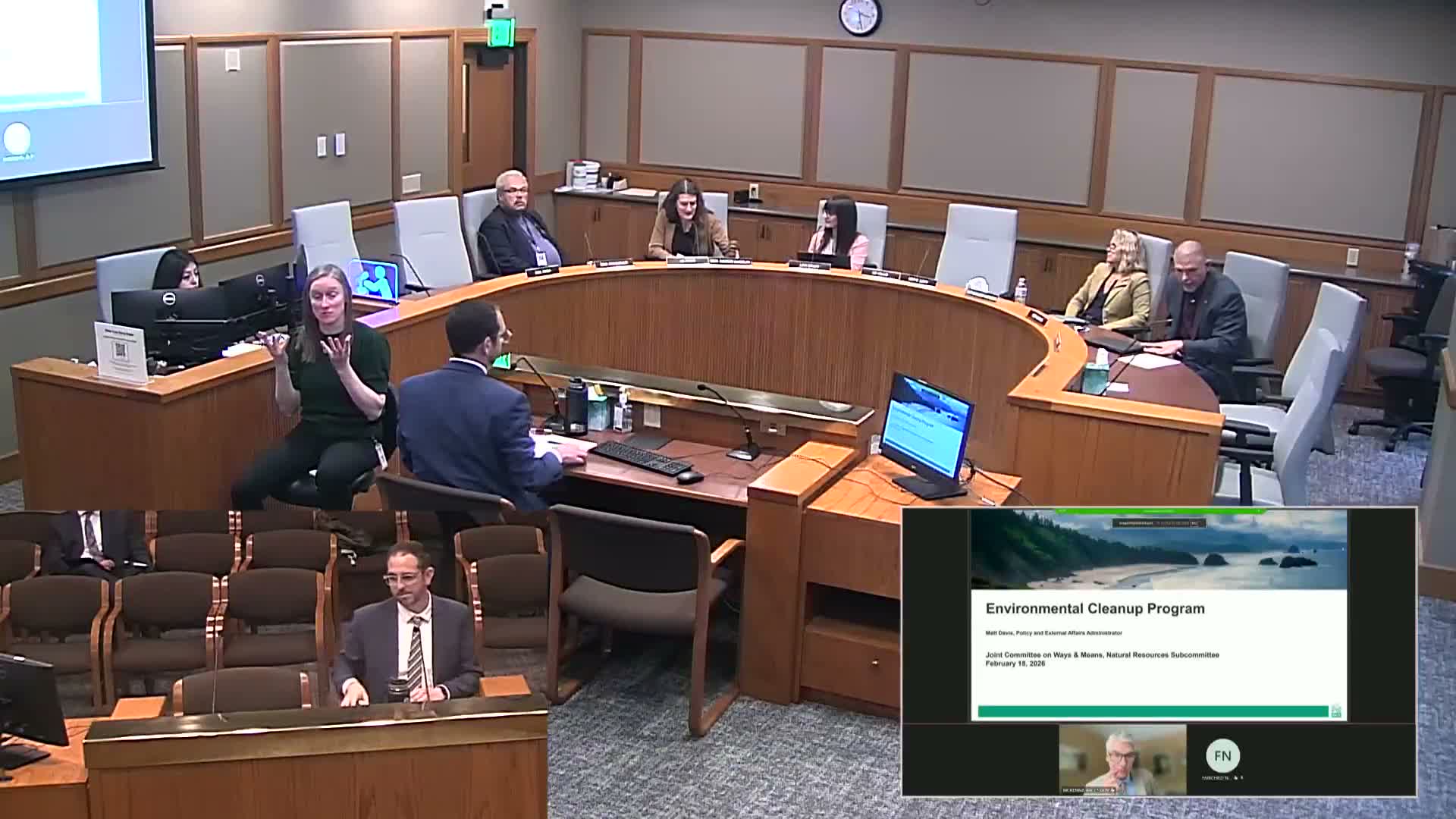
Summary
DEQ told the Natural Resources Subcommittee that Portland Harbor is a complex Superfund site with more than 200 potential responsible parties; remedial design is underway across project areas, dredging could involve millions of cubic yards, and final cleanup costs are now expected to exceed the ROD-era estimate, possibly into multiple billions.
Matt Davis of the Oregon Department of Environmental Quality and Jim McKenna of the governor’s Natural Resource Policy Team briefed the Natural Resources Subcommittee on Feb. 18 on the agency’s environmental cleanup program and the status of the Portland Harbor Superfund site.
DEQ said the cleanup program’s primary mission is to protect human health and the environment from releases of hazardous substances and that much of the program’s work occurs through voluntary cleanups initiated by property owners. The agency reported a biennial program budget of about $61 million and roughly 90 full-time equivalent staff working on cleanup activities statewide.
Jim McKenna described Portland Harbor as one of EPA’s "mega sites": a roughly 10-mile stretch of the Willamette River, with more than 200 potential responsible parties (PRPs) and over 350 adjacent facilities producing a wide mix of contaminants over more than a century. He said EPA’s 2017 Record of Decision identified about 18 areas requiring active remediation — in many places involving dredging or capping of sediments — and that EPA’s plan then anticipated dredging of more than 3,000,000 cubic yards of sediment and active cleanup taking roughly 13 years once work begins.
McKenna cautioned that the 2017 cost estimates are now out of date: "That record of decision estimated the cost to be about $1 billion (2017 dollars) — it was basically $1.7 billion with discounting — and now it's very safe to assume the final cleanup cost for the site is going to be well beyond the billion-dollar range into the multiple billions," he said. He said all project areas are in various stages of remedial design; per EPA quarterly reporting (September 2025), several areas have completed 30% design and begun 60% design while others are just starting.
McKenna emphasized the state’s multi-faceted role at Portland Harbor: Oregon is a potential responsible party, a regulator through DEQ source-control work, a trustee for natural-resource damages (with partners such as the Oregon Department of Fish and Wildlife), and a landowner. He described a state-city incentive that helped move remedial design forward: the city and state each contributed $12 million to a fund that provided roughly $80,000 per acre (about $40,000 from each) to parties that signed agreements to perform remedial design — an approach McKenna said successfully encouraged many parties to step forward.
Senator Frederick (who represents the area including Portland Harbor) asked whether insurers for long-defunct companies had been identified for potential coverage; McKenna confirmed the confidential private mediation requires parties to bring insurance policies and that forensic work is underway to identify potentially applicable policies, and that the state is pursuing recovery when possible. Senator Frederick also asked about the Portland Botanical Garden’s prospective purchaser agreement for the McCormick & Baxter site; McKenna said DEQ had closed its public comment period on the prospective purchaser agreement and that the agency is evaluating comments while the garden pursues funding and partnership support.
Senator Frederick urged more frequent community updates on Portland Harbor work — including district-specific brownfields listings — and DEQ agreed to circulate its cleanup inventory and annual report. Committee staff noted agencies have two working days to provide follow-up materials for posting.
No formal votes were taken; DEQ committed follow-up materials and outreach information to the subcommittee.