Get Full Government Meeting Transcripts, Videos, & Alerts Forever!
Get email alerts on the Climate Pollution Reduction topic
No spam. Unsubscribe anytime.
DEQ outlines rollout of nearly $197 million Climate Pollution Reduction Grant
Summary
DEQ told the Natural Resources Subcommittee it has begun implementing a nearly $197 million Climate Pollution Reduction Grant from EPA, spending about $30 million so far on transport, building and waste measures and issuing thousands of rebates for electric vehicles and heat pumps.
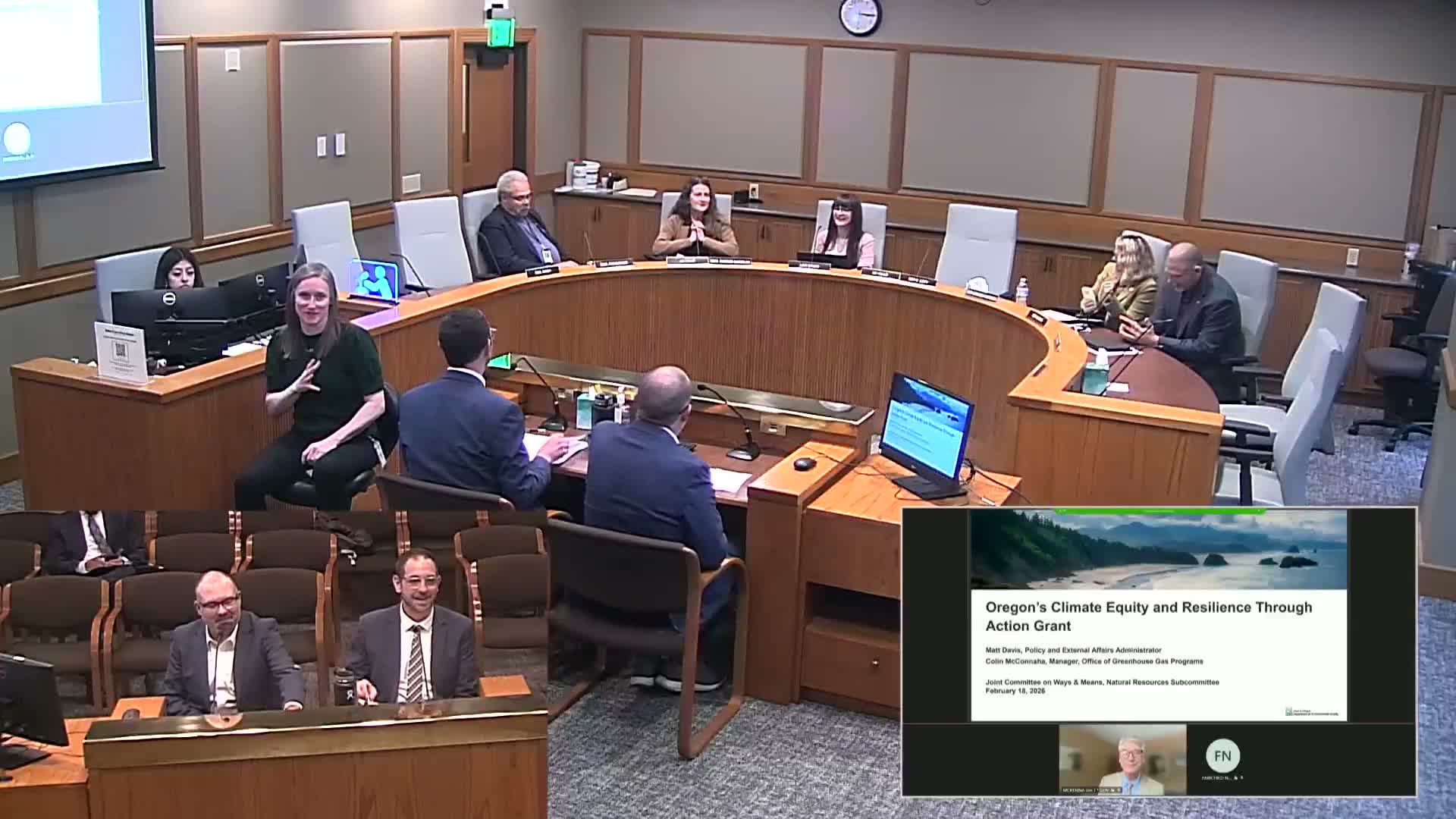
Matt Davis, policy and external affairs administrator for the Oregon Department of Environmental Quality, and Colin McConaughey, manager of DEQ’s Office of Greenhouse Gas Programs, briefed the Natural Resources Subcommittee on Feb. 18 on the state’s implementation of its Climate Pollution Reduction Grant (CPRG).
The CPRG, funded through the Inflation Reduction Act and administered by EPA, is a national program with about $5 billion available. Oregon won one of 25 fully funded implementation awards and received an award the department described as "almost $197 million" to be spent over five years to reduce greenhouse gas emissions and to support related co-benefits such as housing production, improved health outcomes and lower utility bills.
DEQ said the CPRG is organized into 12 measures across three broad areas: transportation, buildings (residential and commercial) and waste and materials management. Transportation programs include the Charge Ahead vehicle rebate for low- and moderate-income households, ODOT’s community charging rebates, and new DEQ incentives for medium- and heavy-duty zero-emission vehicles and fueling infrastructure. Building measures include rebates for new construction efficiency, heat-pump and weatherization incentives administered through the Department of Energy, Energy Trust of Oregon and Oregon Housing and Community Services. Waste measures include grants for composting, lower-embodied-carbon building materials rebates and landfill gas-capture grants.
Colin McConaughey said DEQ has spent about $30 million of the award to date and highlighted early results: "We've issued almost 4,000 Charge Ahead rebates," he said, and the state’s heat-pump program has issued "over 1,200 rebates." He also said the Energy Trust of Oregon has issued roughly 650 rebates for new homes that exceed code efficiency by at least 10 percent. DEQ expects the bulk of the funds to be expended in 2026, with remaining spending through 2029.
Matt Davis emphasized that Oregon’s award was competitive in part because many of the programs the state proposed were already in operation, allowing faster distribution of funds: "Much of the funds that EPA gave to the state of Oregon are going through programs that the legislature had already established," he said.
DEQ told the committee the award is being implemented through partnerships with multiple state agencies, including the Department of Energy (program delivery), the Oregon Department of Transportation (charging infrastructure) and Oregon Housing and Community Services, plus the Oregon Health Authority and the Energy Trust of Oregon for specific measures. McConaughey described a mix of "shovel-ready" measures already operating and more aspirational measures that will take longer to stand up.
Committee members were directed to follow-up materials; DEQ said it would circulate links to the agency’s program inventory and annual report and that staff would post follow-up materials to the legislative information system per committee rules.
The subcommittee did not take formal action on the grant during the hearing. DEQ said it will return with additional materials and that the committee should expect more detailed program-level reports and links to the statewide inventory.