
Lawmakers press DOL on wage-theft enforcement as advocates urge Empire Act funding
Get AI-powered insights, summaries, and transcripts
Subscribe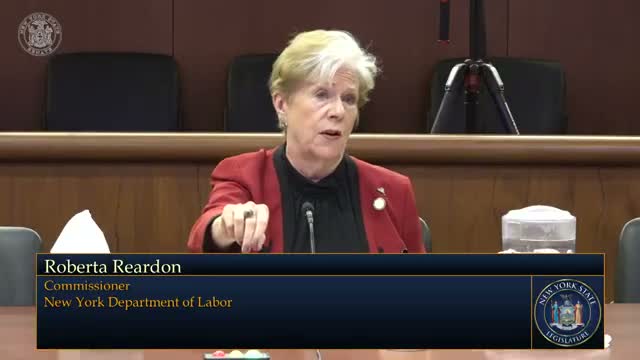
Summary
Legislators pressed the Labor Department about recovered wages and whether proposed funding shifts enforcement to rural DAs; advocates and lawyers urged stronger public enforcement powers and dedicated funding, arguing DOL lacks investigators to address statewide wage theft.
Legislators at the joint fiscal hearing pressed New York State Labor Commissioner Roberta Reardon on wage-theft enforcement and the governor's proposal to fund rural district attorneys with $5 million to pursue criminal wage-theft cases.
Reardon said the department's authority is civil enforcement and that criminal prosecutions by district attorneys are a complementary tool. "Our authority is civil law enforcement. When the DAs pick it up, it's criminal law enforcement," she said, adding that DOL sometimes investigates and then hands cases off for criminal prosecution.
Lawmakers and outside witnesses called for a broader enforcement approach. Commissioner Reardon noted DOL recovered $35 million in unpaid wages and collected $2.2 million in penalties in 2025, figures she said reflect expanded tools such as new lien and penalty provisions. Several legislators urged additional DOL investigator hires and questioned why the executive budget did not increase investigator FTEs more directly.
Outside witnesses and worker advocates pressed for statutory changes to expand public enforcement. Hugh Barron of the National Employment Lawyers Association and others recommended the Empire Worker Protection Act (assembly A4278), which would allow workers, unions or whistleblowers to bring public enforcement actions and would split penalties between workers and the state. Advocates said a new financing model in the bill could generate recurring revenue to expand DOL enforcement capacity and make enforcement less dependent on limited agency staffing.
What happened next: Committee members asked DOL to follow up with a detailed breakdown of the $35 million in recovered wages and the number and caseloads of labor-investigation staff. Witnesses urged lawmakers to consider both criminal prosecutions and strengthened civil enforcement, including penalties and a statutory mechanism like the Empire Act to support scaled enforcement.