Get Full Government Meeting Transcripts, Videos, & Alerts Forever!
Get email alerts on the Immigration Enforcement In Schools topic
No spam. Unsubscribe anytime.
Ways and Means panel approves amended bill limiting school staff sharing of immigration-related information
Summary
The House Ways and Means Committee on Feb. 25 approved an amended bill that bars school personnel from sharing immigration-status information except when presented with a valid warrant, expands protected locations and covered staff, and requires annual Attorney General guidance updates.
The House Ways and Means Committee approved an amended bill on Feb. 25 that restricts school staff from sharing information for federal immigration enforcement except under a valid warrant or legal order.
The measure, moved favorable by committee members after roll-call votes, expands current sensitive-location protections to add courthouses, school buses and bus stops and extends the ban beyond school resource officers to principals, teachers and school counselors. Sponsors also designated the bill an emergency measure and required that Attorney General guidance be updated by Oct. 1, 2026, with covered agencies adopting policies consistent with that guidance.
Sponsor Delegate Ebersole (as identified in the transcript) told the committee the bill "prevents SROs and other school personnel from assisting in an investigation into a student's immigration status, not into their criminal behavior." He said the amendments "expand that ... to cover principals, teachers, and school counselors and require personnel to contact the superintendent when a judicial officer seeks to enforce immigration law in school." He added the bill "doesn't say they have to stand in their way, it says they have to inform them that it's happening." (Delegate Ebersole, transcript.)
Members pressed the sponsor on operational details. Delia Long asked whether school personnel could assist federal agents in criminal investigations; Ebersole replied, "This bill is about sharing information, not about physically assisting." The sponsor and staff underscored that a valid warrant, subpoena or legal order provides an exception: "If they have the warrant, the subpoena, or the legal order, there is an exception there." (Transcript.)
Opponents and skeptics questioned the practical necessity of the bill. Delegate Griffith asked for examples of enforcement inside Maryland schools; the sponsor acknowledged there may be no known in-school incidents but said staff can be approached off-site. The chair cited a September incident in Silver Spring reported in Bethesda Magazine to underscore concerns about student trauma when heavily armed personnel are involved near schools.
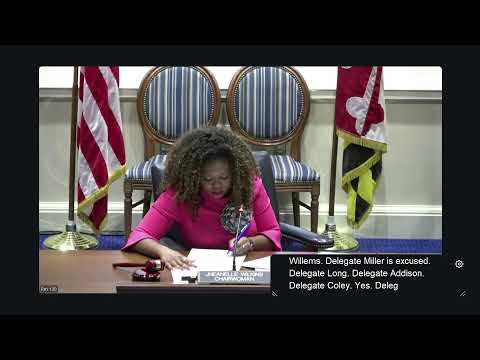
Committee members adopted amendments by roll call and then moved the bill favorable as amended. The roll-call tallies were read into the record; the chair declared "the ayes have it." The committee moved the measure forward favorable as a secondary to the Judiciary Committee and set expectations for the Attorney General to issue or update guidance on implementing the law by Oct. 1, 2026.
The committee's action changes who is covered and where the protections apply; it distinguishes between information-sharing (restricted) and physical assistance (not the bill's subject) and creates a formal pathway for agencies to align policies with updated Attorney General guidance.
The committee will consider bill hearings after the voting session; the measure now advances as amended to the next procedural step.