Get Full Government Meeting Transcripts, Videos, & Alerts Forever!
Get email alerts on the Judiciary Oversight topic
No spam. Unsubscribe anytime.
Rep. Jim Jordan and Sen. Chuck Grassley, per transcript, urged chief justice to reprimand judges who criticized Supreme Court
Summary
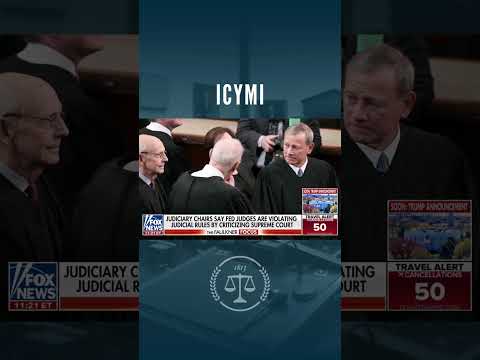
An unidentified speaker said Rep. Jim Jordan and Sen. Chuck Grassley wrote to the chief justice asking him to reprimand federal judges who criticized the Supreme Court in a New York Times survey, highlighting a tension between free-speech protections and judicial canons.
An unidentified speaker said Rep. Jim Jordan and Sen. Chuck Grassley wrote to the chief justice asking him to reprimand federal judges who have criticized the Supreme Court, citing a New York Times survey as the basis for the request.
The account, given in a short media transcript, quoted the speaker as saying, "Now it may sound like federal judges should be able to criticize other courts. We live in America and there's, of course, free speech guaranteed in the constitution." The speaker then emphasized that "there are judicial canons or rules that federal judges must follow," and said Jordan and Grassley contend several judges violated a canon by criticizing the high court.
The transcript does not include direct statements from Jordan, Grassley, the chief justice or the judges named. It reports the lawmakers' action and the allegation that some judges ran afoul of judicial conduct rules, but it does not record any follow-up, rebuttal or formal response from the judiciary.
Legal and ethical debate centers on whether judges' public comments about other courts fall within protected speech or instead violate the judicial canons that govern federal judges' conduct. The transcript frames the issue as a tension between those positions but does not supply evidence that any formal disciplinary proceeding has begun.
The transcript also references a New York Times survey as the source of the judges' critical statements; the transcript does not provide the survey text, the names of judges cited by the survey, or any response from the newspaper. No formal motion, vote or official action on the matter is recorded in the transcript.
The account in the transcript is brief and limited to the allegations and the constitutional-versus-canon framing; it does not include documentary evidence, named replies from the offices involved, or specific canons cited. The transcript therefore records the allegation and the competing principles but stops short of documenting any enforcement or formal inquiry.