
State employees urge bargaining on remote‑work rules as agency cites prior telework policy and pending labor board case
Get AI-powered insights, summaries, and transcripts
Sign Up Free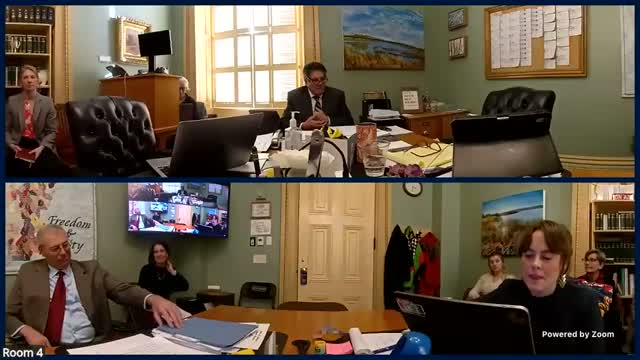
Summary
State employees told the Senate Committee on Government Operations that the administration’s return‑to‑office rollout harmed morale, retention and people with caregiving or disability needs, and urged support for S.228 to require bargaining. Agency leaders said a 2012 telework policy exists and a Vermont Labor Relations Board proceeding is pending.
Senators heard competing accounts Tuesday about S.228, a bill that would require collective bargaining over remote, in‑person and hybrid work standards for state employees.
Mariah Ogden, a Vermont Department of Health employee who spoke using leave time, told the Senate Committee on Government Operations that the administration’s return‑to‑office rollout was hastily implemented and has created operational headaches and lower morale. "Nobody bothered to reconcile my job duties with mailroom access," Ogden said, describing nearly an hour spent trying to send a letter because of changed access. She said the administration acted unilaterally "making major changes to the terms and conditions of state employment" without bargaining and asked senators to support S.228 so the state will "come to the table and bargain."
The bill’s supporters included Jennifer "Jen" Campbell, a public health analyst at the Vermont Department of Health, who said she was authorized in 2023 to work fully remotely from Maine and that remote work kept her in her job during a period when childcare was unavailable. Campbell told senators the return‑to‑office rule would force her either to resign or to move back to Vermont: "My role does not require me to come into the office... Moving to Maine has in no way negatively impacted my role," she said.
Helen Linda, the health department’s public health workforce development coordinator and a VSEA council member, framed the issue as an equity and disability concern. She said collaboration—cited by the administration as a rationale for in‑office requirements—does not fit many department roles and that remote work often enables effective collaboration across district offices. "...people who work in the health department work in the health department because they have a ethical and moral drive to do good," Linda said, describing what she called "disjointed moral injury" from the new policy.
Carrie Brown, who said she directs a commission that submitted written testimony to the committee, presented the commission’s research on gender and equity impacts and urged collection of longitudinal data about who leaves and why. Brown highlighted neurodivergent and disability‑related challenges in open office settings and said the full impact may not be clear for a year or more.
On behalf of the administration, Secretary Sarah McLaren of the Agency of Administration appeared with Beth Festigi, commissioner of the Department of Human Resources, and Emily Kasicki, deputy commissioner of Buildings and General Services. McLaren told the committee that a Vermont Labor Relations Board (VLRB) hearing involving the state and the Vermont State Employees Association (VSEA) concluded in‑person testimony on Feb. 10 and that written briefs are due March 4; the board is expected to rule after that date. She said the parties previously negotiated a telework policy (cited in testimony as Telework Policy 11.9, issued 2012) and that the state considers that policy part of the existing bargaining framework.
McLaren said the administration tried to be transparent in communications about the return‑to‑office plan but declined to discuss litigation‑sensitive details. "My remarks have to be limited today out of respect for the litigation process," she said, and asked the committee not to prejudice the VLRB proceeding.
Committee members pressed agency officials on measurable impacts and on space planning. Deputy Commissioner Kasicki described the BGS approach to leasing and said few state office buildings are fully vacant aside from flood‑damaged sites. Kasicki estimated market rent in the Waterbury area at about $20 per square foot and said new leases related to the return‑to‑office plan represent roughly $400,000 for a full year; she said the Pilgrim Park leases will initially accommodate about 180 employees, and that some desk sharing is expected as departments prioritize space for employees who are in the office more frequently.
Officials said the Cherry Street building was divested in part because of significant subterranean parking garage repair needs; they said the sale and the need for temporary leased space contributed to current office arrangements and that detailed budgetary figures and precise headcounts will be provided to the committee on follow‑up.
No committee vote or formal action was recorded at the hearing. Senators asked the VLRB executive director to provide a timeline for the board decision because a rapid ruling could affect legislative deliberations during the session.
What happens next: written briefs in the VLRB case are due March 4; the board’s ruling could arrive after that date. The committee did not take a formal vote on S.228 at Tuesday’s hearing and requested additional information from agency staff about leasing costs and employee counts.
Sources and attribution: quotes and attributions are taken from testimony delivered to the Senate Committee on Government Operations on Feb. 24, 2026.