
Senate passes bill letting districts recoup community‑college fees when students fail concurrent classes
Get AI-powered insights, summaries, and transcripts
Subscribe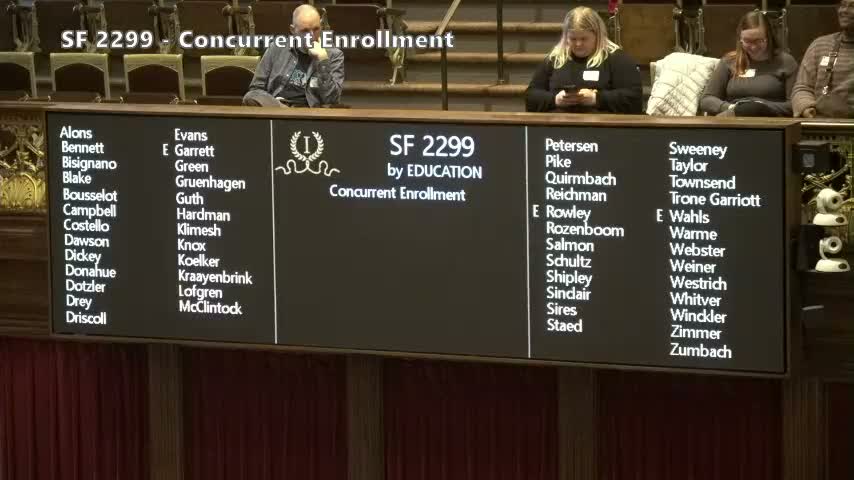
Summary
SF 22‑99 clarifies that school boards may charge students or parents for failed concurrent‑enrollment community‑college classes (up to locally set limits, historically aligned with a $250 PSEO rule); floor debate highlighted concerns that the change could punish ambitious students and reflects broader school‑funding shortfalls.
Senate File 22‑99, sponsored by Senator Green, passed the Senate after an extended floor debate that produced sharp arguments both for local control and against imposing fees on families whose children fail concurrent‑enrollment classes.
Green said the bill merely clarifies existing code and extends to community colleges the authority that has historically existed for PSEO classes, allowing school boards to charge the student or parent (depending on age) for failed classes and to consider cases individually. He described the change as local control: "the parents can go plead their case to the school board as to what the reasons were."
Opponents across the floor argued the measure would chill ambition and unfairly burden families. Senator Buscayano and others said billing parents for a child's failed college course taken while in high school could dissuade students from attempting more challenging work. Several senators tied the issue to underfunding, saying the underlying problem is insufficient state support for schools and concurrent‑enrollment arrangements.
Supporters replied that existing PSEO rules (in administrative code since 1987) already allow a district to recoup costs in some cases and that the bill brings consistency to concurrent‑enrollment funding and expectations. After debate, the Senate recorded passage with a roll‑call (Aye 32, Nay 16).
The measure was ordered messaged to the House by unanimous consent.