
Clark County Council advances unity resolution after public debate over free speech and immigration
Get AI-powered insights, summaries, and transcripts
Subscribe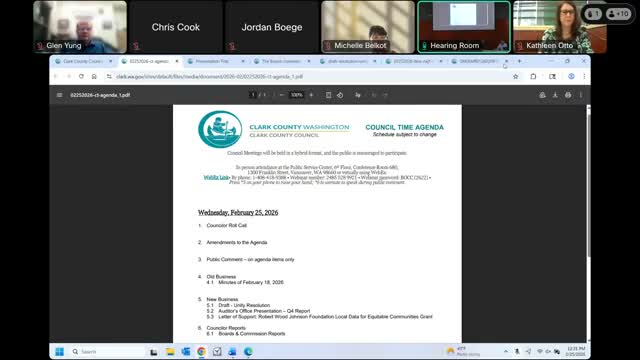
Summary
After public comment split between free‑speech concerns and calls for civility, the Clark County Council agreed to move a draft "unity" resolution forward for further consideration; councilors emphasized it is a nonbinding statement of values, not an enforcement tool.
The Clark County Council on Feb. 25 advanced a draft "unity" resolution aimed at condemning political violence and affirming respect for the county's diverse residents after a lengthy public‑comment period that included competing views on immigration and free speech.
Jordan Bogie, a senior policy analyst, told the council the resolution grew from earlier discussions after a separate Charlie Kirk‑related resolution and is intended to "condemn political violence, threats and intimidation" while calling for a review of the council's code of conduct and efforts to make boards and commissions reflect the community. "The county council commits to reviewing the county's code of conduct for council members and for our boards and commissions," Bogie said as he introduced the draft.
During public comment, Bruce Barnes criticized parts of the resolution and the county's stated focus on "equity and inclusion," linking that language to broader concerns about illegal immigration and uneven treatment of workers. Kimberly Goheen Elvin, participating online, called the resolution a "misnomer" that she said would promote division and asked that the phrase "constitutional rights" be capitalized in the text. By contrast, Julie Koepp of District 2 praised the measure, saying the county should promote "civility, fairness, safety, diversity, dignity and respect."
Councilors spent most of the item clarifying the resolution's intent and scope. Councilor Belcott repeatedly asked how the language about holding boards and commissions "accountable" or "reflective of the community" would be enforced; staff and the county manager pointed to the council's existing rules of procedure and said remedies are limited (for example, a public admonishment) and that the resolution itself does not create new enforceable authority. Councilor Young emphasized the measure is "a resolution, not passing any ordinance or laws or anything that are enforceable," adding it expresses the council's values rather than creating punishment.
After debate over redundancy with prior resolutions and whether to streamline "whereas" clauses, the chair asked for informal agreement to move the measure forward; three councilors signaled support and the chair directed staff to proceed with the next steps in considering the draft.
The council did not adopt the resolution in final form that day; staff and councilors indicated further refinement and review would follow. The council's procedural discussions distinguished between nonbinding policy statements and enforceable personnel or HR actions.
Next steps: staff will continue to edit and return the draft for further council consideration and possible formal action at a subsequent meeting.