
Judge to rule Monday on defense motion to suppress evidence after Greyhound restroom encounter
Get AI-powered insights, summaries, and transcripts
Subscribe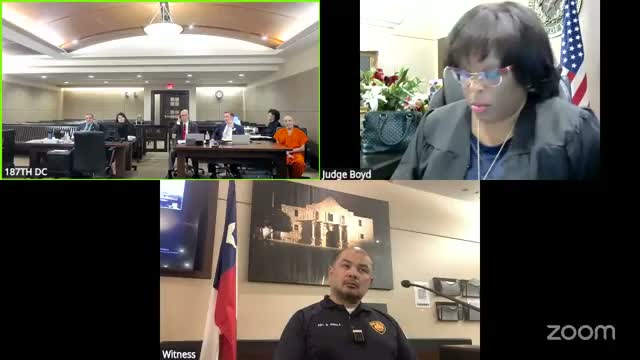
Summary
At a Jan. 10 suppression hearing, defense attorneys asked the court to suppress identity, cash and statements from Juan Martinez, arguing police entered a restroom stall at the Greyhound station without lawful basis; the state said detectives had articulable suspicion and probable cause. The judge took the motion under advisement and will issue a ruling on Monday.
A San Antonio judge took under advisement a defense motion to suppress identity, cash and statements obtained after officers forced entry into a restroom stall at the downtown Greyhound bus station and detained Juan Martinez on Jan. 10, 2024.
Defense counsel argued the stop and search were unlawful and coercive, asking the court to suppress Martinez’s identity, the cash found on him and any statements he made. "They broke the door open. They dragged him out to the floor, his pants still down, handcuffed him," defense counsel told the court, urging that the events showed a search and seizure conducted without the specific articulable facts required under the Fourth Amendment and Texas law.
The state replied that detectives had specific articulable facts linking Martinez to an ongoing narcotics investigation involving Ryan Westbrook, a person the detectives had been surveilling. Prosecutor Brandon Prater told the court that Martinez had been seen with a known narcotics trafficker, had no luggage, and spent only a brief time in the area — facts the state said were consistent with a courier role and justified detention and subsequent searches.
Witness testimony and admitted video exhibits played a central role in the hearing. A detective testified that earlier investigative steps involving Westbrook — including a separate methamphetamine investigation and later discovery of a kilogram-sized package of cocaine in a traffic stop — prompted surveillance that led officers to detain Martinez at the Greyhound station. The detective also acknowledged he had ‘‘no direct knowledge’’ at the moment a bus arrived that Martinez was on it and that some factual connections (such as the passenger ticket’s destination) were established only after questioning suspect Westbrook.
The State introduced patrol and body-worn-camera stills and video (admitted as State exhibits M4, M9, M10 and M11) showing the traffic stop where officers found a backpack and a brick-like narcotics package later described as about the size of a kilo. Defense exhibits M2 and M3 — stills showing two juvenile females and one carrying a sunflower-pattern backpack — were also admitted without objection; defense emphasized that the backpack was held by a juvenile and that Martinez was not an occupant of the vehicle where the package was found.
Defense counsel questioned evidence handling and chain-of-custody, pointing out a delay between the event (01/10/2024) and the detective’s written report (01/18/2024) and pressing whether officers wore gloves when opening the backpack and handling suspected narcotics. The detective testified that he could not recall wearing gloves and that crime-scene personnel typically process and swab evidence; he identified another detective, Justin Ramirez, as the likely evidence collector.
The parties also disputed whether Martinez was detained, arrested, or subject to custodial interrogation under Texas rules of evidence (the defense argued custodial conditions existed because Martinez was handcuffed and questioned in a restroom stall). The state countered with legal citations and case law — including Castro v. Texas, Herrera v. State and Terrazas — arguing officers had reasonable suspicion and that the detention and subsequent statements were lawful.
Judge (Presiding) announced she would review the cited authorities and issue a ruling on Monday; she invited the parties to submit additional case law and offered to provide the transcript to the defense before trial if needed. The court closed the record on the hearing and ordered that exhibits be left with the court reporter.
Next steps: The court will issue a written ruling on the motion to suppress on Monday. If the judge denies the motion, the defense indicated it will request the transcript in advance of trial.