Get Full Government Meeting Transcripts, Videos, & Alerts Forever!
Get email alerts on the Nextgen 911 topic
No spam. Unsubscribe anytime.
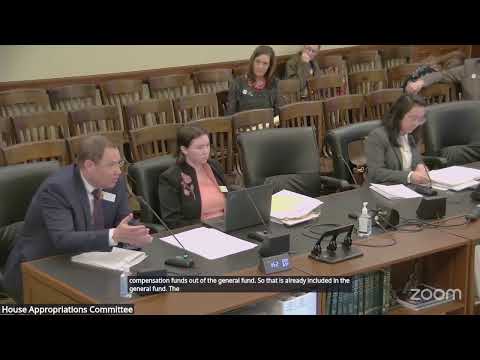
House Appropriations advances bill to study NextGen 911 and fund immediate PSAP gaps
Summary
The committee voted to pass Senate File 32, which pairs a $750,000 study of NextGen 911 (report due 09/01/2027) with a $3,000,000 Department of Transportation‑administered grant program to cover current PSAP deficits and shortfalls while the state plans a long‑term transition.
Senate File 32, a product of interim work by the Joint Interim Corporations Committee, passed the House Appropriations Committee after proponents described the state’s 911 network as stressed by aging infrastructure, staffing shortages and limited redundancy.
Senator Case, who presented the bill, said lawmakers converted a previously prescriptive proposal into “what we call a study bill” that pairs a planning effort with near‑term grant support. The bill would appropriate $750,000 for a Department of Transportation‑led study — including stakeholder input on governance, operations, expenses, efficiencies and funding — with results due to the Joint Corporations, Elections and Political Subdivisions interim committee not later than Sept. 1, 2027. It would also establish a $3,000,000 grant program administered by the Department of Transportation to address pressing PSAP (public safety answering point) needs across counties while the state prepares a long‑term plan.
Why it matters: Wyoming has at least one PSAP per county and multiple PSAPs in some counties. Committee members and witnesses said the combination of 24/7 staffing requirements, leased circuits and aging copper infrastructure has produced frequent outages and a funding gap for smaller, rural centers. Supporters said the study will identify whether consolidation, standardized equipment or a statewide governance approach can deliver more resilient, cost‑effective service.
Supporters from local government and emergency services stressed real outages and operational risk. "The ability to route around those types of issues where a shovel gets misplaced or hits fiber... is a huge thing," said Chris Coker of the Wyoming Fire Chiefs Association. Nate Smolinski, YDOT’s chief technology officer and statewide 911 coordinator, told the committee the $3,000,000 figure was derived from a five‑year average of reported collections versus expenditures across PSAPs and is intended for deficit gap funding rather than an immediate NextGen buildout. "That number... is a five‑year average based upon the reports that are sent in from the PSAPs," Smolinski said.
Rural operations: Matt Johnson, chief of police in Torrington, said his agency’s communications center covers about 2,200 square miles and receives the bulk of its revenue from 911 fees set at $0.75 per line in 1986; he said operating costs now far outpace that revenue. "We've spent about $4.50 for every dollar of revenue that we receive," Johnson said, arguing the grant program would help small centers "keep the lights on" while the study determines a long‑term path.
Program design and questions: Witnesses and committee members discussed whether the Rural Health Transformation Program funds could be applied to aspects of the 911 effort; Department of Health Director Stefan Johansen said RHTP may supplement interoperability or non‑infrastructure items if regions are formed, but federal parameters limit use of RHTP for major capital infrastructure. Committee members also questioned the bill’s flexible language and whether $3,000,000 is sufficient; proponents described the appropriation as a stopgap and emphasized that the study will clarify long‑term needs.
Committee action and next step: Vice Chairman Pendergraft moved the bill and Representative Smith seconded. The committee approved Senate File 32 on a roll‑call vote (7 Aye). The bill will be presented on the floor for the next procedural step.
Provenance: The bill was introduced in the committee hearing beginning with the agenda item (discussion starting SEG 015) and through testimony, public comment and the committee roll call (final action recorded SEG 1177–SEG 1196).