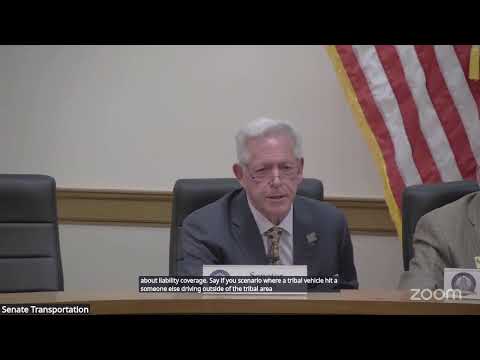
Committee advances bill allowing state officers to enforce English-proficiency test for commercial drivers
Loading...
Summary
A Joint & Standing committee voted to move House Bill 32, which adopts the federal English-proficiency roadside test into state law and allows any Wyoming peace officer to administer it; proponents cited safety and enforcement data, while critics warned of bias and economic harm.
House Bill 32, a measure to allow Wyoming peace officers to enforce a federal English-proficiency test for commercial motor vehicle drivers, was moved out of committee after supporters cited safety data and law-enforcement readiness and opponents raised concerns about bias and economic effect.
Lieutenant Colonel Karl Germain of the Wyoming Highway Patrol told the committee the bill adopts the English-language proficiency test referenced in federal regulation 49 CFR 391.11 and grants any peace officer in Wyoming the authority to administer that test at the state level. "The intent of the bill is to make sure that people who can't read road signs, don't pose a threat to our motoring public," Germain said, describing the measure as a state-level tool for removing unsafe drivers from the road.
Lieutenant Kyle McKay, also with the highway patrol, provided enforcement figures to underline the problem the patrol says the bill addresses. He said the federal rule became an out-of-service regulation on June 25, 2025, and that "from 06/25/2025 to 01/31/2026, the Wyoming Highway Patrol has had 775 violations for this particular regulation within Wyoming," including 337 citations and 19 repeat offenders who were incarcerated on the violation.
The bill, as explained in committee, does not give non‑certified officers the full authority to perform federal Level 1–3 commercial-vehicle inspections; rather, it allows non‑federal inspectors to administer the standardized English‑proficiency test roadside and to take drivers out of service or assess state penalties when drivers fail. The draft creates a state statutory section (recorded in the bill as 31-18-608) adopting the federal test, sets a $1,000 penalty with an additional $1,000 and potential jail time for repeat offenses, and provides a separate section (31-18-701) authorizing the highway patrol division and other enforcement agencies to enforce the provision. The House amendment made the law effective immediately rather than July 1.
Supporters included the Wyoming Trucking Association and the Wyoming Association of Sheriffs and Chiefs of Police (WASCOP). Kevin Hawley of the Wyoming Trucking Association said Wyoming has been aggressive in enforcement and voiced support for taking unsafe drivers off the road while noting the state measure is limited to English‑language proficiency rather than full commercial inspections. Alan Thompson of WASCOP said local agencies had been coordinating training with the highway patrol and had no objection to enforcing the statute once it becomes law.
Opponents warned of civil‑rights and economic consequences. Albany County resident Kendra Kelly, speaking online, said the bill "goes far beyond existing federal standards and creates a system ripe for discrimination and abuse," arguing the vague standard could invite bias based on accents or stress during a traffic stop and could harm immigrant drivers and the state economy.
Committee debate included questions about implementation details—how the department would designate agencies or officers to enforce the statute and how records would be used to identify repeat offenders. Patrol witnesses said ports of entry, county sheriffs and municipal police would be covered and that inspection records and driver-history checks are already used to track repeat violations.
Senator Cobble defended the bill as safety‑focused, saying it is "nothing to do with profiling anybody except for highway safety." The committee voted by roll call to move House Bill 32 (mover: Senator Glucobes; second: Senator Barlow). The clerk recorded Senator Anderson excused; Senators Barlow, Cooper, Kulp and Chairman Pappas voted Aye, carrying the motion (4 ayes, 1 excused).
The bill will proceed from committee for further floor action.