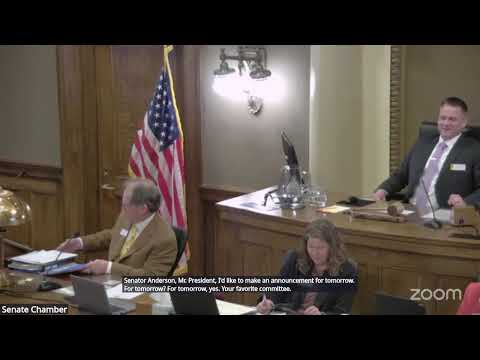
Senate advances bill to codify local government sales-tax distribution formula after narrow debates and rules challenge
Loading...
Summary
House Bill 107, which would codify a formula for city, town and county shares of sales tax revenues (commonly called the Madden formula), passed the Committee of the Whole after senators debated percentage levels, the effects in downturns, and a Committee of the Whole amendment that was ruled out of order by the Rules Committee.
House Bill 107, a measure to codify local government distributions of sales and use tax receipts, won a favorable recommendation from the Committee of the Whole after extended debate on formula percentages and the risks of entrenching a statutory distribution.
Sponsors described HB107 as the long-standing Madden formula made statutory and explained the amendment moving the distribution percentage (discussion begins at SEG 2394). Debate focused on whether codifying the distribution into statute could create rigidity during economic downturns. Senator Hicks urged the body to include "escape clauses" or mechanisms to adjust distributions in recessions to avoid legal or fiscal vulnerabilities. He and others warned that fixed distributions tied to sales-tax receipts could create a conflict with other state obligations during revenue declines (SEG 2688–2746).
Senator Steinmetz offered a Committee of the Whole amendment to sweep a $54.9 million off-budget Business Ready account into the general fund and allocate it through a consensus block grant; that amendment was debated but ultimately ruled outside the bill's title by the Rules Committee and was not adopted. The Committee of the Whole otherwise adopted a standing committee amendment and reported HB107 do pass as amended.
What happens next: HB107 will return to the Senate for further readings. Sponsors and critics signaled willingness to consider second-reading changes to provide flexibility or triggers for adjustments during economic downturns.