
Senate committee adopts amendments to post-election audit bill after debate over observer rules and clerk workload
Get AI-powered insights, summaries, and transcripts
Subscribe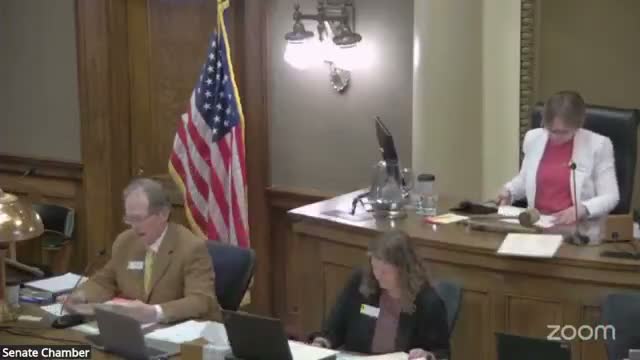
Summary
House Bill 85, which formalizes post-election audit procedures and observer rules, advanced from the Committee of the Whole with amendments specifying oath requirements, limiting observers to prevent disruption, and clarifying who qualifies as a differing political affiliation; senators debated constitutional privacy and county clerk capacity.
House Bill 85, which codifies procedures for post-election audits, advanced from the Committee of the Whole on Wednesday with amendments intended to balance public observation and ballot privacy.
Sponsors said the bill would require minutes for post-election ballot audits, require county clerks to notify party chairmen and candidates of audit times and places, and allow observers from different political affiliations to witness audits. The standing committee amendment gave clerks discretion to limit attendance when space constraints would impair the audit, and it replaced an explicit "two different political parties" requirement with a broader "different political affiliations" standard (discussion begins at SEG 881).
Concerned senators asked whether the Management Audit Committee was the right venue and whether county clerks and election officials had been adequately consulted. Senator Schueller moved a Committee of the Whole amendment to tighten access to ballot images and invoked the state constitution's privacy language, quoting Article 6, Section 11, to argue against broad public access to ballot images (SEG 1141–1146). Schueller urged caution to avoid making ballot images publicly accessible simply because an observer signed an oath.
Supporters and members of management audit explained the measure responds to incidents where post-election audits had not been performed consistently and where no observers were present, and argued that codification provides accountability and a clear process for county clerks. Senators asked for additional clarity on "political affiliation" and sought assurance that clerks would not be overburdened by the new obligations (multiple exchanges, SEG 998–1060, SEG 1208–1240).
The Committee of the Whole adopted the standing committee amendment and the Committee of the Whole amendment; the bill was reported out with a due-pass-as-amended recommendation.
What happens next: HB85 will return to the full Senate for second reading with the adopted amendments; senators requested additional clarifying language and confirmation of support from county clerks ahead of final votes.