
Chilton County commissioners consider creating emergency medical response authority amid volunteer gaps
Get AI-powered insights, summaries, and transcripts
Sign Up Free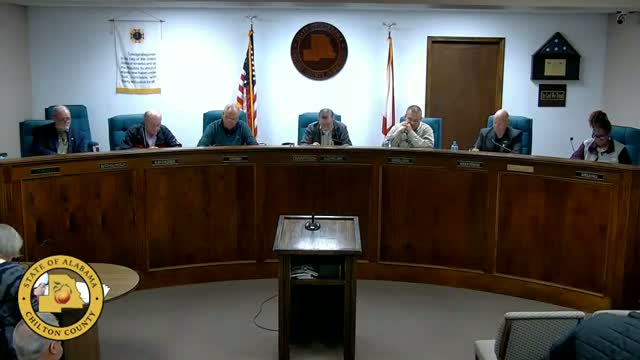
Summary
Commissioner Billingsby proposed forming a Chilton Emergency Medical Response Authority to add paid rescue and transport capacity, citing volunteer shortages and multi-hour ambulance delays; commissioners asked staff for a business model, governance options and funding plans before any vote.
A Chilton County commissioner on Tuesday urged the commission to ask county legal staff to draft bylaws for a new emergency medical response authority that would provide paid rescue personnel and limited transport capability to supplement the county's contracted ambulance provider.
Commissioner Billingsby introduced the proposal, saying volunteers sometimes do not respond to calls and contracted ambulances (RPS) can take 30 minutes to an hour or longer to arrive. He proposed a five-member authority to hire a director and about 32 paramedics/EMTs working in two-person crews (48 on/48 off) with shift commanders and the capacity to transport patients when RPS is unavailable. "We need to be prepared for a catastrophe," he said, and asked that the county attorney draw bylaws and record the authority so the commission could consider nominees.
Why it matters: Commissioners described the proposal as a potential way to shorten response times for critical incidents when current mutual-aid and contracted services are overwhelmed. Several speakers noted the county's reliance on volunteers and mutual aid makes some calls take too long, and they argued a transport-capable rescue unit could bridge gaps for cardiac arrests, major wrecks and other time-sensitive events.
Debate and next steps: Commissioners pressed for written financials and a clear governance plan before formal approval. One commissioner flagged competition concerns and cost uncertainty, saying the county's own service could undermine the business model of the incumbent contractor and later raise contract costs. Estimates presented in the meeting ranged from about $2.5 million per year (preliminary operating staffing estimate provided by the proponent) to as much as $4 million for start-up costs according to another commissioner. Members also discussed whether to create an independent authority (with reduced direct commission control) or a board subject to commission oversight.
Speaker Billingsby pointed to an immediate equipment funding opportunity (an Alabama Joint Fire Council EMS equipment grant open Feb. 18 Mar. 31) but others emphasized grant awards would not substitute for sustainable operating funds. Billingsby said three experienced local leaders had agreed in principle to serve on a planning board (Joe Cole, Brent Conway and Michael Minor) but told the commission those names would not be formally presented until a legal authority existed to accept nominations.
What happens next: No formal action was taken Tuesday. Billingsby said he will ask the commission to make a motion at the next meeting that the county attorney draft and record bylaws for the authority and return a recommended governance and funding plan. Commissioners asked staff to prepare a written business model, a cost analysis and governance options before any final vote.