Get Full Government Meeting Transcripts, Videos, & Alerts Forever!
Get email alerts on the Solar Ordinance topic
No spam. Unsubscribe anytime.
Iberia Parish council adopts solar ordinance with half-mile setback after hours of public comment
Summary
After extensive public comment and debate, the Iberia Parish Council adopted a revised solar ordinance that sets a half-mile setback from residences and creates an industrial development board appointed by the council; developers and opponents sharply disagreed over outreach, safety and property impacts.
The Iberia Parish Council on July 23 adopted an ordinance regulating utility-scale solar development that sets a half-mile minimum setback from residences and creates an Industrial Development Board whose members will be appointed by the council.
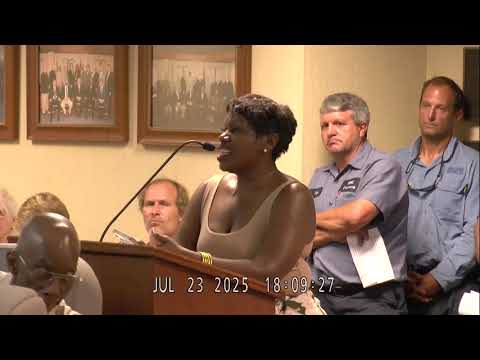
The move came after more than three hours of public comment and a lengthy council debate in which industry representatives urged more time and broader outreach and dozens of residents and landowners urged strict limits or a full ban. Ben Callahan, representing Recurrent Energy, said the company had conducted canvassing and a public meeting and reported that "1,902 people said they were in favor" while "776 ... said they were opposed," asking the council for more time to expand engagement.
Why it matters: The ordinance replaces an absence of parish rules on utility-scale solar with a local regulatory framework that is stricter than the state’s 300-foot baseline. Supporters of a larger buffer argued a wider setback protects property values, rural character and safety; supporters of development warned an overly broad setback risks an effective ban on solar and may expose the parish to legal challenges.
Experts and industry responses: Terry Chambers, a professor of mechanical engineering at the University of Louisiana at Lafayette, said the technology is governed by tests and engineering standards and stated, "When solar is implemented according to all appropriate codes and standards, it is absolutely safe for the public." Recurrent Energy representatives, including Joshua Chevalier, raised procedural and legal concerns: Chevalier told the council the draft ordinance and its timing "does not conform to the requirements of the Home Rule Charter for Iberia Parish" and warned that a one-mile setback would function as "a functional ban on solar in Iberia Parish."
Residents’ concerns: Dozens of residents who live near the proposed project area described fears about noise from inverters and transformers, wildfire and chemical risks from damaged panels, loss of farmland and lower home values. Speakers cited studies and local experience while urging the council to prioritize residents who live adjacent to proposed sites.
Council action and amendments: Council members debated multiple amendments. A proposal to adopt the second draft (which had included a one-mile setback) failed. Council members then approved an amendment that reduced the setback to a half-mile and specified that the industrial development board’s members be appointed by the parish council; that amendment was adopted and the ordinance passed as amended. The council did not record a roll-call vote tally in the public remarks at the time the ordinance was adopted.
What’s next: The ordinance creates a permit and review process and authorizes technical requirements — including drainage plans, decommissioning bonds and emergency response commitments — that will be worked out in implementing rules and permit applications. Council members and staff said additional public-notice and variance procedures will be refined as the parish implements the ordinance.
Other business: The meeting also included routine budget and millage items, several resolutions and committee work on capital projects and maintenance, which the council handled after the solar item concluded.
The council set regular further business for its next meeting on Aug. 13, 2025; implementation details for the solar ordinance — including permit timelines and technical conditions — remain to be completed through the parish review process.