Senate committee advances five‑year tax exemption for enhanced oil‑recovery projects after panel narrows scope
Loading...
Summary
Senate committee advanced House Bill 128 to grant five‑year severance‑tax exemptions for incremental production from enhanced oil‑recovery projects, deleting a reference to gas after Department of Revenue concerns; testimony emphasized project economics and expected acceleration of several Wyoming EOR projects.
Representative Tarver presented House Bill 128 as a targeted, five‑year exemption on incremental production from tertiary (enhanced) oil recovery meant to accelerate projects that require large up‑front capital. "It is when the production starts to increase is when this tax goes into effect," Tarver said, and he stressed the exemption applies to incremental production rather than existing output.
An ERI representative summarized historical outcomes from past exemptions (2003–2008) and said incremental production in earlier EOR projects produced larger lifetime tax receipts than the initial phased exemptions suggested. ERI cited examples including Salt Creek and Patrick Draw and said certain new projects could require startup investments on the order of $250 million.
Tom Kropatch, director of the Oil and Gas Conservation Commission, said the commission would treat certification as commencement of injection and that severance‑tax reductions would not begin until incremental production was observed; the department would coordinate with the Department of Revenue to verify incremental volumes.
Matt Sachet of the Department of Revenue raised a statutory‑definition issue: the committee’s existing statutory definition for tertiary production refers to crude oil recovered from a petroleum reservoir and does not include natural gas or NGLs, so the committee addressed that by striking the words 'and gas' from page 1, line 2 of the bill. Industry witnesses (Petroleum Association) argued the exemption drives investment and long‑term revenue and disputed media reports that suggested large negative fiscal impacts.
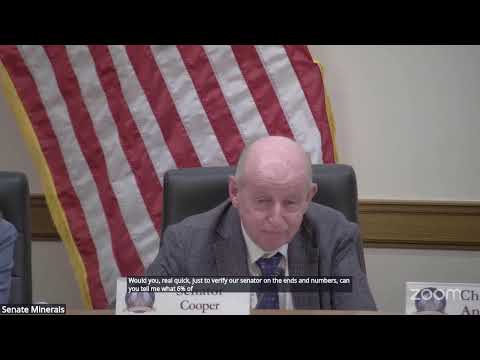
Committee action and next steps: The committee adopted an amendment removing 'and gas' from the text to align the bill with current statutory definitions, then took a roll‑call vote to advance House Bill 128 as amended; Sen. Cooper is slated to present the bill on the floor.