Wyoming committee advances bill to regulate virtual‑currency kiosks after reports of widespread scams
Loading...
Summary
The Senate Minerals Committee advanced House Bill 75 to require registration and oversight of virtual‑currency kiosks after testimony that kiosks have been used in scams targeting seniors, with the banking commissioner directed to adopt implementing rules. The committee added an immediate‑effect amendment and approved the bill on a roll call.
Representative Costin, the bill sponsor, told the Senate Minerals, Economic Development and Business Committee that House Bill 75 grew out of reports from local law enforcement and consumer groups about kiosk‑facilitated fraud that has hit older residents in particular. “My local law enforcement came to me and informed me about these virtual kiosks and all the fraud and abuse that was going on,” Representative Costin said, and she cited $3,000,000 in losses in Campbell County last year.
Banking Commissioner Jeremiah Bishop outlined how he would implement the measure through rules if it passes. Bishop said operators would have to register each kiosk location with the division, adopt transaction limits for non‑onboarded customers, require clear disclosures and signed customer acknowledgments, set limits on fees and provide refund mechanisms for transactions later determined to be fraudulent. He said he would require operators to use blockchain‑analytics tools to flag known scam wallet addresses and that, currently, Wyoming regulators know of roughly six operators and more than 60 kiosk locations statewide, with three operators licensed as money transmitters.
Consumer and industry witnesses offered competing perspectives. Tom Laycock of AARP urged oversight and said kiosks charge much higher fees than exchanges — “with these machines, we’re seeing between 20 to 25%” — and described fraud patterns such as jury‑duty and impersonation scams that drive victims to kiosks. Bobby Frank, testifying on behalf of credit unions, described members who lost hundreds of thousands over multiple transactions and supported immediate consumer protections. CoinFlip representatives said the firm already uses analytics, posts warnings and holds a money‑transmitter license; an online CoinFlip expert, Claire Wolfson, said CoinFlip’s internal estimate of illicit activity at its machines is about 1% and that the company is open to wait‑periods for new users and paper receipts in limited cases.
Senators pressed for specifics. Members asked whether convenience‑store employees or kiosk operators removed warning notices posted by local police, whether kiosks could be used to launder cash, and how quickly the banking division could promulgate emergency rules if the committee made the act effective immediately. Bishop said emergency rule drafting could start right away and filing could take roughly 30 days, while licensing unregulated operators could take several months.
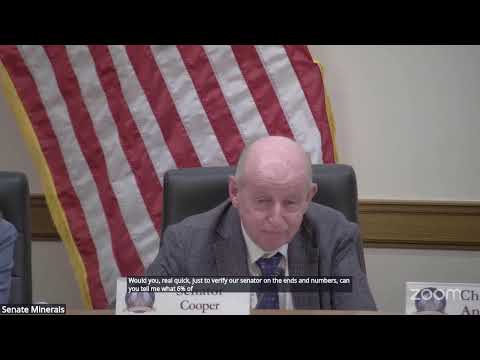
Committee action and next steps: Sen. Nethercott moved to advance the bill; the committee adopted an amendment to make the act effective immediately, which would require unlicensed kiosk operators to stop operating until they obtain a money‑transmitter license. The committee also approved a motion to strike unused defined terms after discussion that those details can be better shaped in rule. On a roll call, the committee recorded ayes from Senators Cooper, Jones, Nethercott, Rothfuss and Chairman Anderson and advanced the bill; Sen. Rothfuss is slated to present it to the full Senate.