Get Full Government Meeting Transcripts, Videos, & Alerts Forever!
Get email alerts on the Blight And Derelict Policy topic
No spam. Unsubscribe anytime.
Roanoke staff propose new blighted and derelict property tax to push long‑vacant sites toward repair or redevelopment
Summary
City staff presented an ordinance to create a separate tax classification for blighted and derelict properties, allowing a premium tax rate, a tracking program and court tools to convey long‑vacant parcels to localities or developers with redevelopment covenants. Council asked detailed questions on definitions, appeals and implementation.
Roanoke staff on Monday presented an ordinance creating a new city code classification and assessment for blighted and derelict property that would let the city apply a higher tax rate to chronically neglected sites as a tool to encourage remediation and reuse.
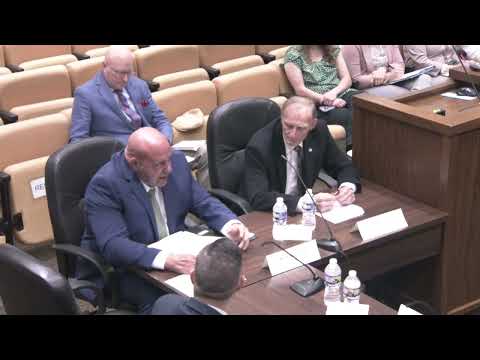
Kelvin Bratton, director of real estate valuation, told City Council the proposal would add a Division 10 to the city code and — citing a state code reference in the presentation — allow a tax premium on properties determined to be blighted or derelict. Bratton showed example rates in the staff presentation: "for example, if it's blighted, we can charge a 5% premium above standard real estate tax rates" and for derelict buildings a 10% premium. Under staff examples, the current tax rate of $1.22 per $100 of assessed value would move to $1.28 under a blight classification and $1.34 under a derelict classification.
City Attorney David Collins explained the legal mechanics: state law authorizes localities to assess higher rates for blighted or derelict property and the higher rate would go into effect the July 1 following the date a determination is made. Collins also described a newly effective state statute staff flagged that will allow a locality to petition the circuit court to appoint a special commissioner to convey abandoned property to the locality or a land bank, subject to conditions in the statute and local process. He said the conveyance tool requires the property to be vacant, tax‑delinquent and—per staff discussion—to have been vacant for an extended period before the locality uses the court process.
Staff emphasized coordination with code enforcement and an appeals pathway similar to reassessment challenges. Bratton said the program would be supported by an internal database to track vacancy and compliance and that property owners could be removed from the list upon bringing the property into compliance. Collins described statutory safeguards and noted owners would have the usual notice and redemption opportunities if the locality pursued conveyance under the court process.
Council members pressed staff on several procedural and practical points: how to distinguish "habitable" from "uninhabitable" in the field and photos, integration with the rental/inspection program, technical capabilities of the treasurer's billing software, and whether the program would apply to commercial as well as residential properties. Staff said they will confirm legal definitions, finalize coordination with code enforcement and the treasurer's office (staff reported the city’s vendor, Catalyst, can support the required billing layers), and conduct targeted public outreach before implementation.
Bratton and Collins also described deed covenants the city could require if it conveys a property to a third party under the new statute: a developer would be required to commence work within six months and to remedy building code violations within two years. Staff said those covenants are part of the statute's implementation guidance and would be options for the locality to ensure timely redevelopment.
City staff said an implementation timeline would follow adoption, with an internal rollout and public notice; staff noted an effective program start was set in their presentation materials as 07/01/2025. Council members generally expressed support for the tool while raising questions staff pledged to resolve before a final ordinance return to council.
The Council did not vote on the ordinance during the briefing; staff asked for council feedback and said they would return with more fully defined definitions, outreach plans and ordinance language.