
Iowa House approves school funding bill with 2% increase; 5% Democratic amendment fails
Get AI-powered insights, summaries, and transcripts
Subscribe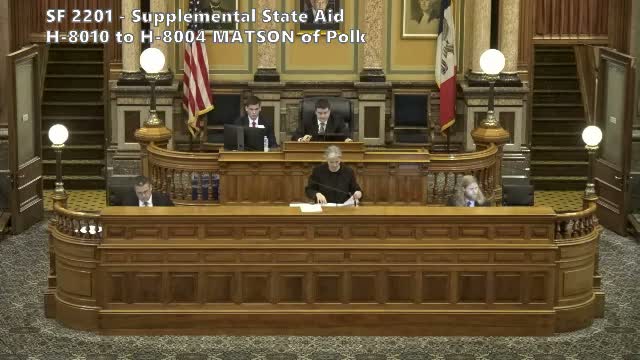
Summary
The Iowa House passed Senate File 2201, increasing supplemental state aid by 2% and shifting some property-tax replacement costs to the state; Democrats' proposed 5% increase failed on a 30–63 roll call. The measure now moves to the Senate.
The Iowa House on Thursday passed Senate File 2201, a school-funding measure that raises the state supplemental state aid (SSA) by 2% for the 2027 fiscal year, sets the state cost per pupil at $8,148, and directs the state to pick up budget-guarantee costs for districts with enrollment declines. The House recorded a final roll call of 58 yeas to 35 nays, with seven absent or not voting.
Representative Matson, offering a Democratic amendment that would have increased school funding by 5 (about $400 per pupil) and included $14 million for education support professionals, urged colleagues to back a larger investment. "This is about priorities," Matson said, arguing that higher funding would reduce class sizes, support paraeducators and bus drivers and address special-education deficits. Matson asked for a recorded division; the amendment failed on a roll call, 30–63, with seven members absent.
Supporters of the bill, led in debate by Representative Gehlbach, said the amended measure represents a responsible approach that balances funding with fiscal stability. Gehlbach highlighted recent gains in student outcomes and attendance and said the bill would add roughly $105.9 million in new general-fund dollars on top of existing state and local resources. "This bill delivers over 100,000,000 in new money to our schools," Gehlbach said, while noting the total state aid appropriation in the bill is about $3.98 billion and that total K–12 resources in Iowa exceed $11 billion annually when local and federal funds are included.
The adopted amendment package includes (per the amendment text summarized on the floor) a 2% SSA increase for fiscal 2027, an extended property-tax relief payment for one additional year, a transportation-equity adjustment (capped per district), a second student-count date on Jan. 15 to better align funding to enrollment, and a $7 million supplement for education support personnel. The bill text on the floor specifies an effective date and applicability beginning 07/01/2026.
Lawmakers on both sides described local impacts. Republican supporters said the bill protects taxpayers while preserving stability for districts; Democrats and several House members representing urban and high-poverty districts — citing examples such as Sioux City and Waterloo — warned that the 2% increase does not make up for years of underfunding and could leave many districts with significant deficits or on the state budget-guarantee list. Representative Turek cited a decade-long real decline in school staffing power and said a 2% bump would not keep pace with inflation. Representative Ramirez described community partners and wraparound services that are often the first to be cut when districts face tight budgets.
The House disposed of multiple amendments during the floor session: Representative Gelbach (as recorded on the floor) moved amendment H8012 (a strike-after amendment that became the bill) which was adopted; the appropriations amendment H8004 was adopted as amended. Representative Matson's earlier amendment (H8010), proposing a 5% boost, was defeated in a roll call. After passing the bill, the House ordered the measure messaged to the Senate.
Following passage, Representative Kaufman moved to adjourn; the House agreed and reconvened at the time set by the motion.
What happens next: The bill now moves to the Senate for consideration. The House roll-call result was 58–35 in favor, with seven members absent or not voting.