
Ojai Valley Fire Safe Council outlines outreach, home‑hardening work and a regional resilience plan
Get AI-powered insights, summaries, and transcripts
Sign Up Free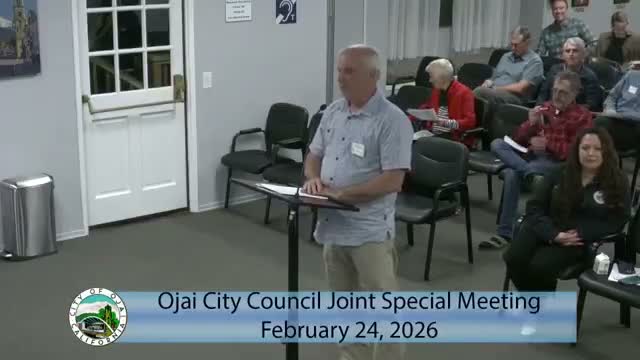
Summary
The Ojai Valley Fire Safe Council reported progress under its professional services agreement, saying it reached hundreds through workshops, completed 25% of a home‑hardening assessment target with 77 pending, and urged city participation in a regional resilience and mass‑care planning grant.
The Ojai Valley Fire Safe Council gave the city council its first quarterly presentation under a professional services agreement, summarizing outreach and wildfire‑mitigation work performed from October through December. Christopher, speaking for the council, said teams have delivered multiple community workshops and home‑hardening assessments, and that the program has completed roughly 25% of its stated target while 77 assessments remain pending.
Christopher said the contract covers two broad areas: community outreach/education and wildfire risk mitigation. He described recent engagements — workshops at the Ojai Garden Club, the Ojai Valley Hospital Guild and the Ojai Lions Club — that generated sign‑ups for home hardening assessments and a steady stream of community questions focused on ember risk, Zone 0 requirements and defensible space. “We’re 25% of the way there in the first quarter,” he told the council, and noted a software glitch in January slowed scheduling but has been resolved.
The council also previewed events and training the organization is planning under the agreement: a Wildfire Resilience Festival on April 25 and an NFPA wildfire‑resistant construction course scheduled for May (with a second session in August). Christopher said the organization has added one full‑time staff member and two contractors to support the work and described continuing collaboration with the Ventura River Watershed Council on a $2,000,000 watershed resilience grant.
On governance and next steps, the presenter asked the city to participate in two formal committees — an operational working group to look at infrastructure needs for a conversion project (the former Honor Farm) and a community advisory board to advise on programs and services. He said the project will require an operations and maintenance plan for future grant rounds and suggested the city could act as a co‑applicant on infrastructure grants that exclude non‑profit applicants. He referenced competitive state funding, noting the first round awarded a limited number of planning grants and stressing that municipal partnerships can improve eligibility.
Council members asked about county coordination, beacon box siting, and the extent to which the city might support the project financially. Christopher said Ventura County is a strong partner, that county fire supports some proposed measures, and that beacon‑box siting had been in the project’s original scope but was removed from the city contract; he said the council could expect a future proposal on that point. Staff said they will continue reporting back to council and will refine recommendations informed by combined data from local and regional home‑hardening assessments.
The presentation closed with an invitation to participate in committees and followup workshops and with a reminder that the full status report and timeline are available on the Fire Safe Council and city websites.