
House committee hears wide support for $911 million supplemental capital budget (HB 2295)
Get AI-powered insights, summaries, and transcripts
Subscribe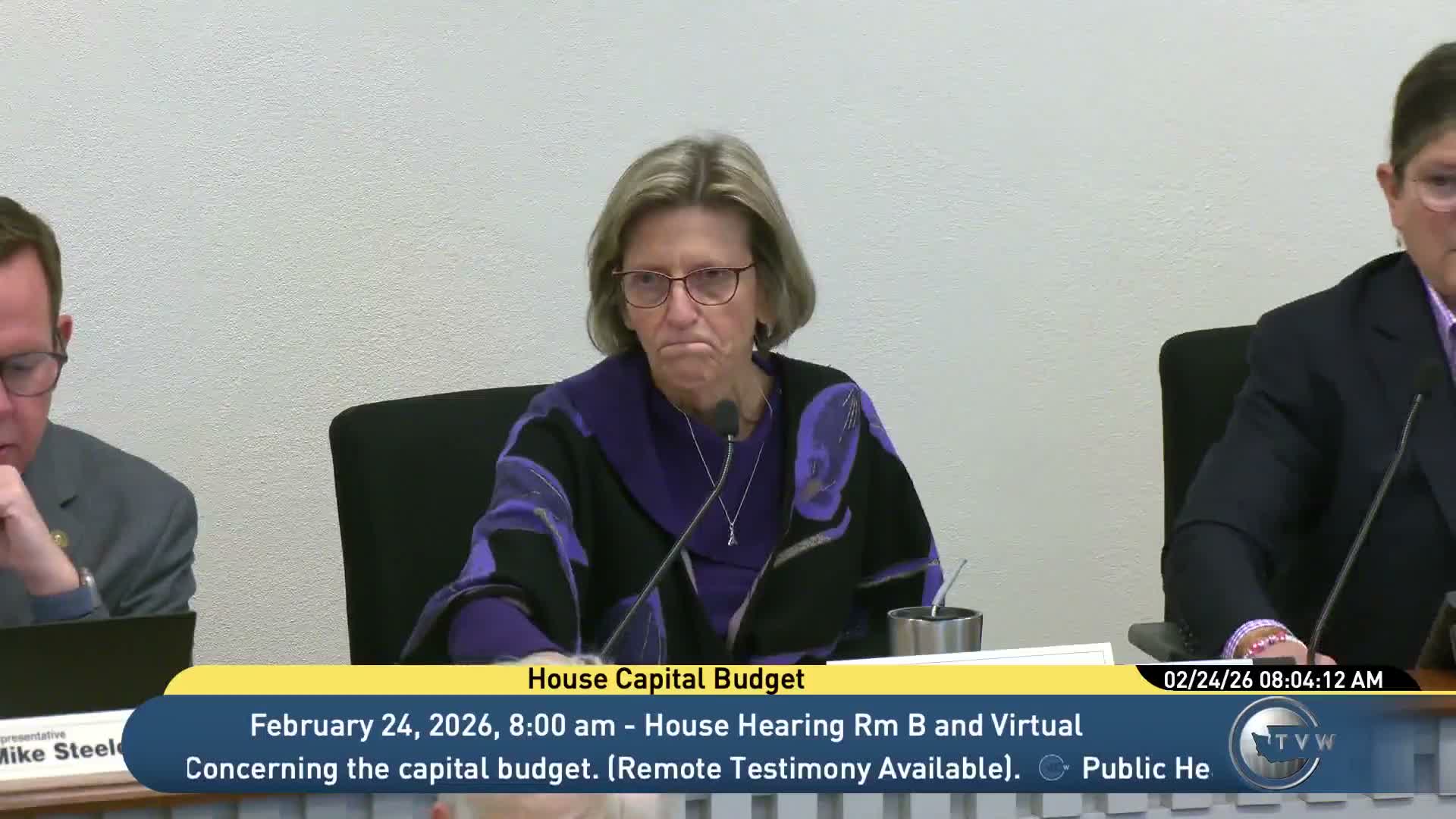
Summary
The Washington House Capital Budget Committee heard hours of testimony on substitute House Bill 2295, a near-$911 million supplemental capital budget that increases Climate Commitment Act spending and includes major investments in housing, K‑12, higher education, floodplain resilience and behavioral health facilities.
The Capital Budget Committee on [date not specified] reviewed substitute House Bill 2295, a proposed supplemental capital budget that committee staff summarized as roughly $911,000,000 in total spending, including about $400,000,000 in bonds and approximately $639,000,000 in Climate Commitment Act (CCA) appropriations earmarked across new capital programs and account changes.
John Wilson, committee staff, told members the House proposal would redirect $239,000,000 through account changes to free up higher education building revenue for operating needs while leaving capital projects whole. He identified major line items including $221,600,000 for housing and homelessness projects, $78,400,000 for K‑12 capital construction, and $69,500,000 for improvements to human services facilities.
Testimony came from dozens of local officials, tribal leaders, university and college trustees, nonprofit executives and municipal staff, who largely praised targeted investments while urging the committee to preserve or increase funding for specific projects during negotiations with the Senate.
Speakers highlighted a range of projects that the House proposal funds or omits: tribal courthouse replacement funding for the Quinault Indian Nation, community forest acquisitions prioritized under CCA spending, multiple affordable‑housing and preservation projects tied to the Housing Trust Fund, school electrification dollars, university decarbonization work and floodplain resiliency projects supported by a Floodplains by Design allocation. Several speakers asked the House to match or retain Senate funding levels for individual projects.
No formal committee votes were recorded during the hearing. Vice Chair Kallen closed the meeting and reminded members the committee does not take amendments to the capital budget at the hearing and that the bill is expected to move toward a vote later in the week.
What happens next: Committee members and staff will enter conference negotiations with the Senate; several witnesses urged preserving House funding levels for housing and community health projects as those talks proceed.