
Texas DPS urges tighter behavioral threat assessment teams, asks council to back bill protecting clinicians' participation
Get AI-powered insights, summaries, and transcripts
Sign Up Free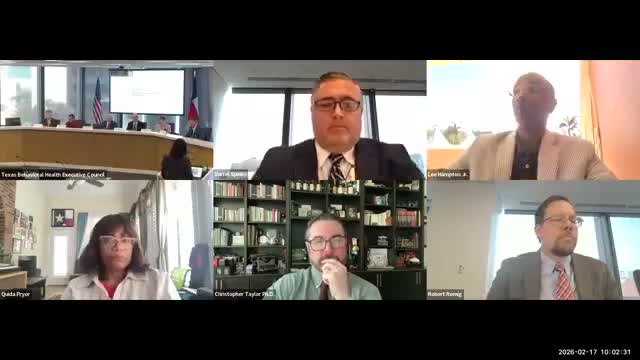
Summary
Major Sharon Jones told the Texas Behavioral Health Executive Council DPS has established statewide behavioral threat assessment and management teams that have thwarted multiple targeted‑violence plots and asked the council to support draft legislation to protect mental‑health professionals who share clinical information within those confidential teams.
Major Sharon Jones of the Texas Department of Public Safety told the Texas Behavioral Health Executive Council on Feb. 17 that DPS has built statewide behavioral threat assessment and threat‑management teams that bring law enforcement, school officials, hospitals and mental‑health professionals together to identify and intervene with individuals on a recorded “pathway to violence.”
“See something, say something,” Jones said in introducing the program; she added the question her presentation addressed was “what happens when we say something.” Jones described the teams as multidisciplinary and confidential and said their mission is to reduce risk while respecting civil liberties.
Jones presented multiple Texas examples she said were stopped by coordinated teams, including an Austin‑area case in which investigators prevented an 18‑year‑old from buying an assault weapon and later found bomb‑making materials and weapons in his home. She described another individual allegedly scouting a parade route and a person attempting to enter a daycare with a firearm. “We literally stopped a targeted violence within Texas last year,” she said.
DPS outlined how mental‑health professionals participate: they provide clinical interpretation of behavior, give context for medication and diagnostic history and help the teams decide on interventions that are more likely to reduce future risk than arrest alone. Jones said teams also conduct monitoring and, in exigent circumstances, convene quick‑response calls that can last 15 minutes to an hour.
Council members pressed DPS about how teams operate in rural areas and how participation is staffed. Jones said teams are already operating statewide and that DPS will travel long distances to respond; some meetings are virtual and mental‑health professionals can sometimes join by Zoom. She said DPS provides the heavy lifting for investigations and asks clinicians to contribute focused clinical judgments about diagnosis and medication effects.
On legislation, Jones said the governor’s directive does not compel other agencies or clinicians to join but directed DPS to form teams and carry out an implementation plan. Jones asked the council for help shaping a bill that would permit mental‑health professionals to share otherwise confidential clinical information inside an assessment team meeting while limiting disclosures outside the team. "What we need is language that you are comfortable with, to know that you are protected in behavior threat assessment," she said.
Council staff and several board members expressed support for engaging on legislation and for testifying if the legislature pursues it. Staff noted training and continuing education are part of DPS’s outreach; DPS said its annual conference offers CE credit and that attendees can receive a certificate for credits.
The council did not take formal action on a legislative text at the meeting. Staff said they will participate in drafting and refining bill language if the legislature acts and that they are prepared to advise on statutory limits and confidentiality language.
What’s next: DPS staff and council members said they will continue drafting the statutory language and that DPS will provide additional briefings to the member boards. The council suggested staff and members with clinical expertise assist in shaping a “safe‑harbor” or other protections for clinicians who participate in threat‑assessment teams.