
Muskego council defers vote on wide water‑capacity amendment after lengthy public hearing
Get AI-powered insights, summaries, and transcripts
Subscribe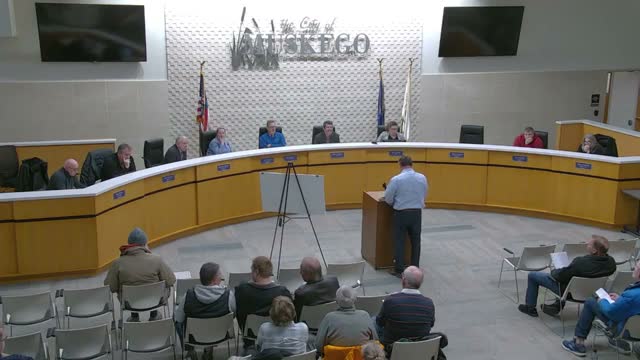
Summary
After a public hearing with dozens of residents raising questions about cost, mandatory hookups and well impacts, Muskego City council deferred a resolution amending the city’s area‑wide water capacity assessment (WCA) tied to the Kirkland Crossing subdivision until its March 10 meeting for more information and a narrowed map.
Muskego City councilors on Feb. 24 heard a large turnout of residents during a public hearing on Amendment No. 20 to the city’s area‑wide water capacity assessment (WCA), then agreed to postpone a formal vote to March 10 to give staff time to refine the proposed map and answer resident questions.
The amendment was driven by the developer’s extension of water main for the Kirkland Crossing subdivision and would formally include surrounding properties in the WCA so those properties could later connect to the municipal water utility if public mains and adequate pressure become available. City staff said the amendment itself does not immediately extend water mains or require connections.
Why it matters: The WCA determines which properties may be assessed for the cost of future water infrastructure. Residents in the large area notified by the city asked for clarity about when mains and pressure would be present, whether hookups would be mandatory, potential costs to homeowners and impacts on private wells.
City engineer Scott (first name only in the record) said, “You will not be forced to connect to municipal water except on point of sale and if water is available,” explaining that the city requires both a water main in front of a property and sufficient pressure before assessments or mandatory hookups would apply. He added that there are no current plans to extend mains beyond the Martin Road run that serves Kirkland Crossing.
Several residents urged that hookups be voluntary. Brandon Bontzak asked why “surrounding properties are being included as a formality” and urged the council to make connection optional rather than automatic at sale. Robert James Stricola said, “Nothing should be forced, period, on any of us,” reflecting comments from other speakers who said they were satisfied with existing wells and could not afford an unexpected $10,000–$20,000 hookup cost.
Council debate centered on two options: approve the larger amendment area as drafted to reduce administrative cost and keep parcels eligible for future development, or narrow the map to include only the Martin Drive/Kirkland Crossing corridor and adjacent lots directly served by the new main. Alderman Decker said he wanted more time for fact‑finding; other members suggested staff could produce a trimmed map that addressed residents’ concerns without jeopardizing the developer’s ability to receive water service.
Outcome and next steps: A motion to defer consideration of Resolution 01.3.2026 (the WCA amendment under Wisconsin Statute 66.0703) carried; the council postponed the vote until its March 10 meeting so staff can prepare alternative maps and answers to the community’s technical questions. Residents were encouraged to follow up with the city clerk, the mayor or engineering staff for specific, parcel‑level questions.
What the record shows: The public hearing record and later council discussion emphasized that an approved WCA map would not itself extend mains or force immediate hookups; assessments and mandatory connections would only apply when mains are installed and pressure is validated at a property. The city also noted that the Wisconsin Department of Natural Resources handles well testing requirements for wells retained after municipal water becomes available.
The council did not adopt the WCA resolution on Feb. 24; councilors instructed staff to return March 10 with a more narrowly tailored map and additional materials addressing residents’ concerns.