Get Full Government Meeting Transcripts, Videos, & Alerts Forever!
Get email alerts on the Interconnection And Consent Agenda topic
No spam. Unsubscribe anytime.
FERC approves consent agenda; commissioners highlight interconnection reforms and NERC inverter standards
Summary
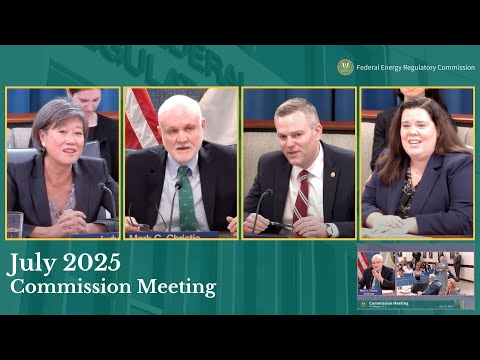
The Federal Energy Regulatory Commission approved its consent agenda — including multiple electric, hydro and certificate items — by recorded voice votes and spent much of the meeting underscoring interconnection reforms and NERC inverter-based resource standards intended to speed connections and bolster reliability.
The Federal Energy Regulatory Commission approved its morning consent agenda — covering electric items E1–E5, hydro items H1–H3 and certificate items C1–C3 — by recorded voice votes, and commissioners used the meeting to emphasize efforts to speed generator interconnection and strengthen reliability standards for inverter-based resources.
Commissioners recorded their votes in the roll call. Commissioner Chang said, “I vote aye.” Commissioner Singh and Commissioner Rosner each recorded “I vote aye.” The chairman indicated his assent on the record. The consent agenda listing was read into the record by staff, who also noted that G1 had been stricken from the morning agenda and that the commission had issued 80 notational orders since the 06/26/2025 open meeting.
Beyond the vote, commissioners discussed recent and forthcoming actions meant to reduce delays in getting new generation built and connected. Commissioner Rosner described a generator that has been “in the queue 8 years” and told the commission that because original equipment is no longer manufactured the project must seek a waiver to allow updated hardware to be incorporated into engineering studies. Rosner said the commission’s 2023 generator interconnection reforms aim to “unlock” efficiencies so new generation gets online faster.
Commissioner Seay and others praised recent filings and RTO/ISO work (including references to PJM, MISO and SPP) intended to reduce interconnection friction and urged continued industry–commission cooperation. Commissioners repeatedly framed the measures as ways to limit avoidable delay at the final stages of connecting new resources to the grid.
Commissioner Rosner also highlighted NERC’s evolving inverter-based resource (IVR) ride-through standards, saying broad stakeholder input informed the rules and that they are “critical for the ongoing work of just being smart about the grid.” He said those standards aim to help avoid system events similar to a recent Iberian Peninsula outage discussed with NERC.
Documents handed to commissioners or staff during the open meeting, staff noted at the outset, do not become part of the official record nor require further commission action. The meeting was adjourned after closing remarks and staff introductions.