Get Full Government Meeting Transcripts, Videos, & Alerts Forever!
Get email alerts on the Market Design topic
No spam. Unsubscribe anytime.
FERC conference speaker urges average incremental‑cost pricing to eliminate uplift payments
Summary
At FERC's software conference, Richard O'Neil argued for average incremental cost (AIC) pricing to replace make‑whole/uplift payments, saying AIC would produce clearer price signals and better investment incentives; he cited MISO data and ORDC volatility as evidence.
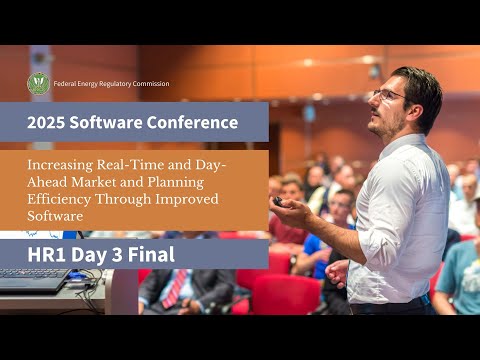
Richard O'Neil, a longtime FERC official and presenter at the Federal Energy Regulatory Commission's 2025 software conference, urged regulators and market operators to adopt average incremental cost (AIC) pricing to eliminate make‑whole and uplift payments and produce clearer scarcity signals.
O'Neil told the room that current day‑ahead and real‑time markets are incomplete and that “you have to institute AIC pricing,” which he said removes uplift payments while remaining revenue neutral and “individually rational” for generators. He said AIC produced about 10% higher energy prices in tests on MISO data but argued that the higher energy revenues would lower overall investment costs by improving profit signals for infra‑marginal generators.
O'Neil criticized stopgap fixes such as ELMP and convex‑hull approaches as inadequate for resolving nonconvexities caused by unit commitment. He also highlighted the instability of administrative scarcity signals, citing Winter Storm Yuri as an example: regulators raised ORDC to "$9,000" and later moved it to "$5,000," a change O'Neil said undercuts investment certainty.
On demand participation, O'Neil pushed for much greater involvement by large customers, saying that if sizable consumers actively bid into markets, scarcity prices become consumer‑driven rather than set by a regulator's loss‑of‑load calculation. He suggested large customers — on the order of tens of megawatts — must be part of the market for AIC to work as intended.
During Q&A, FERC policy staff and attendees raised implementation questions, including how to amortize fixed costs across durations and how unsophisticated consumers would receive or react to prices that are not known until after settlement. O'Neil acknowledged those challenges but emphasized phased engagement of large customers and operational changes in day‑ahead and real‑time processes.
The presentation did not propose a specific implementation timeline or immediate regulatory action; O'Neil said he intends to continue discussions with ISOs and other market participants to test and promote the approach.