Lifetime Citizen Portal Access — AI Briefings, Alerts & Unlimited Follows
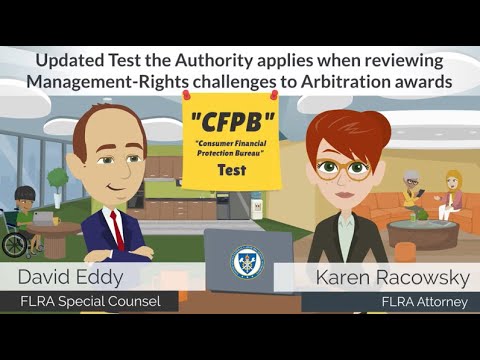
FLRA training: Four-step CFPB test for management-rights challenges in arbitration appeals
Loading...
Summary
A training video from presenters David Eddy and Karen Rakowski explains the Federal Labor Relations Authority's four-step CFPB test, which the authority uses to decide when arbitration awards intrude on management rights under 5 U.S.C. 7106 and when remedies must be revised or remanded.
David Eddy and Karen Rakowski, presenters in a Federal Labor Relations Authority training video, outlined the Authority's four-step CFPB test for reviewing challenges to arbitration awards under 5 U.S.C. 7106.
They said the test applies when an arbitrator finds a violation of a collective-bargaining agreement (not when an arbitrator finds a violation of law) and that the Authority assumes an arbitrator's interpretation of the contract is correct unless a party separately argues the award fails to draw its essence from the agreement. "We call it the CFPB test," Rakowski said, pointing viewers to the linked decision, 73 FLRA 670.
The test has four parts. First, the accepting party must show the award affects at least one of the 19 management rights listed in 5 U.S.C. 7106(a). Eddy explained that an award can affect rights either through the arbitrator's interpretation or application of the agreement (for example, limiting management's ability to discipline) or through the arbitrator's chosen remedy (for example, directing rescission of discipline).
Second, the Authority asks whether the contract provision, as the arbitrator interpreted and applied it, is enforceable under 7106(b). Rakowski summarized that 7106(b) covers three categories: b(1) permissive matters that agencies may bargain over, b(2) procedures management must bargain, and b(3) appropriate arrangements for employees adversely affected by management rights. She referenced precedent including 21 FLRA 24 (the CANG test) and noted the CFPB decision presumes tailoring for b(3) arguments but that parties may seek to rebut that presumption.
Third, an accepting party must challenge the remedy separate and apart from the finding of a contract violation; if no separate remedy challenge is made, the Authority will deny the management-rights exception at step 3, the presenters said.
Fourth, the Authority examines whether the remedy reasonably correlates to the enforced provision as interpreted and applied. Rakowski offered an example: setting aside discipline correlates to a finding that just cause was lacking, but directing a promotion would not reasonably correlate to a contract provision requiring just cause for discipline. If the Authority sets aside a sole remedy, it will typically remand to the arbitrator to supply a different remedy so the contract violation is not left unremedied; if other remedies remain in place, the Authority generally will not remand.
The presenters stressed practical points for practitioners: make management-rights arguments in arbitration because the Authority will not consider arguments that were omitted below; agencies should identify when a proposed interpretation or remedy would conflict with management rights; unions should explain why the contract provision fits within 7106(b) and why requested remedies reasonably correlate to the contract interpretation. "The authority will not consider arguments that a party could have made but did not make to the arbitrator," Eddy said.
The video concludes by recommending that parties read the CFPB decision and related Authority precedent and by directing viewers to the video description for links to the decision, a flowchart, and other resources.