
Committee advances bill to restrict student restraint and ban purpose-built isolation rooms
Get AI-powered insights, summaries, and transcripts
Subscribe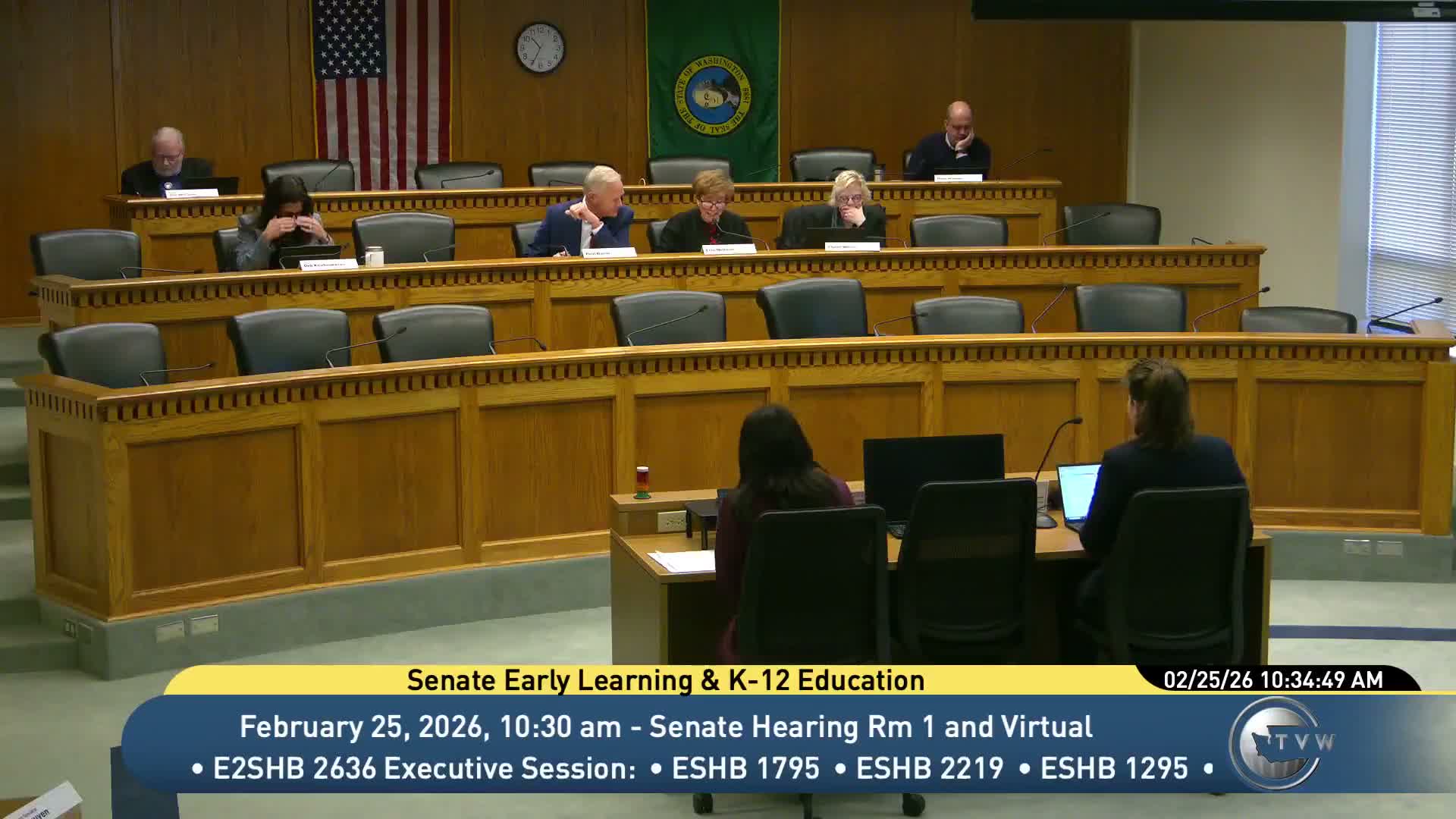
Summary
The Early Learning & K–12 Education Committee advanced Engrossed Substitute House Bill 1795, which narrows authorized uses of restraint and bars rooms designed primarily for student isolation while adding reporting requirements tied to school resource officers; an amendment to the striking amendment failed before the bill received a due‑pass recommendation to the rules committee.
The Early Learning & K–12 Education Committee on Monday advanced Engrossed Substitute House Bill 1795, a measure that would limit mechanical, chemical and life‑threatening physical restraints on students and curtail the use of isolation in public schools.
Eileen Kato, committee staff, summarized the bill, saying it “prohibits mechanical restraint, chemical restraint, and physical restraint or physical ****** of a student that is life threatening,” and that the proposal would bar construction or repurposing of any room or enclosed area whose primary purpose is student isolation. Kato said the bill would also prohibit planned isolation as a behavioral intervention under individualized education programs and 504 plans and would extend restraint and isolation requirements to most providers of public educational services, with limited exceptions for licensed inpatient health professionals.
The striking amendment labeled A, offered by Senator Wellman, would add intent language targeting implementation of trauma‑informed professional development by 2031, require technical assistance to operationalize an isolation ban, and tighten reporting when incidents involve a school resource officer, Kato said. Senator Nobles offered an amendment (A1) to the striking amendment; the committee voted against A1. The chair described the vote on A1 as failed.
After rejecting A1, the committee voted to recommend that the bill as amended by striking amendment A receive a due‑pass recommendation and be sent to the rules committee. The chair announced the bill had "passed subject to signatures." The committee conducted votes by voice; no roll‑call tally was recorded in the transcript.
A fiscal note on an earlier version was available, and staff said the Office of Superintendent of Public Instruction (OSPI) estimated no fiscal impact while recognizing district impacts were indeterminate.
The committee also clarified the bill’s definition of temporary removal and nonpermanent barriers: Kato said temporary removal from a regular instructional area and voluntary use of quiet space are not covered as isolation, and removable classroom barriers that leave a student within staff line of sight are treated differently but still trigger reporting requirements.
Next steps: HB 1795 was recommended to the rules committee; if taken up by the full Senate, it would proceed through the regular floor and final‑pass process. The committee did not record a roll‑call vote in the transcript and noted the bill is “passed subject to signatures.”