Get Full Government Meeting Transcripts, Videos, & Alerts Forever!
Get email alerts on the Local History topic
No spam. Unsubscribe anytime.
How the Lincoln Highway shaped lodging in Springettsbury: a century of inns, motels and redevelopment
Summary
Steven Smith traced the rise of inns and later motels along the Lincoln Highway (East Market Street) in Springettsbury Township, documenting 14 historic lodging places, notable openings from 1752 to the 1960s, and a present-day inventory of nine active hotels providing about 742 rooms.
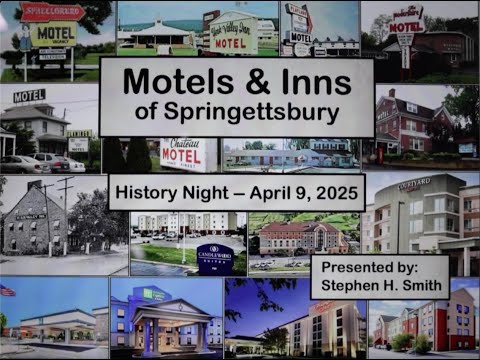
At History Night, Steven Smith, chairman of the Springettsbury Township Historic Preservation Committee, presented a chronological survey of lodging along the township’s 3.7-mile Lincoln Highway corridor, from 18th-century taverns to midcentury motor courts and present hotel developments.
Smith said the township’s earliest recorded lodging was the Valley Inn (the site later known as the Ye Olde Valley Inn), with origins cited to 1752, and he recounted ownership changes under the Houston family and later occupants before the building’s 1962 demolition to widen East Market Street for the York Mall. He identified Emig’s (Amig’s) Hotel as another early establishment (opened 1847) and noted its conversion to a private home after 1916.
Moving through the 20th century, Smith described a cluster of roadside tourist camps and cabins after the Lincoln Highway’s 1913 designation — including the Big Hand tourist camp (opened 1925, charged 50¢ per night in 1927) and the Highway Bridge service station (opened 1928) which rented cabins and later operated a lunchroom into the 2000s. He cited a sequence of 14 lodging places that opened along East Market Street and walked the audience through representative sites and dates: Hotel Paddock (1946), Modern Air Motel (1949), Barnhart’s/Gladys Tourist Home (1951), Chateau Motel (1951), Stony Brook Motel (1953), Spiele(Spiegel) Grand Motel (1953), Hoffman's and Flamingo Motels (both 1957), York Valley Inn (1959), Playland Pool Motel (1960) and the Holiday Inn (1964) — now operating as Quality Inn & Suites.
"There were quite a few in that very short span," Smith said, adding that 14 lodging businesses once lined the Lincoln Highway and that, as of 2025, only three of the original midcentury motels remain from that set: the Chateau (1951), the Flamingo (1957) and the Holiday Inn/Quality Inn (1964). Smith listed recent, larger hotels added nearby — Hampton Inn (1992), Courtyard by Marriott (2011), Holiday Inn Express (2012), TownePlace Suites (2013) and Candlewood Suites (2017) — and summarized that the township now has nine active hotels totaling 742 guest rooms.
Smith also highlighted local redevelopment pressures: he said the Modern Air Motel and Barnhart’s Motel both closed in 2024 after developer activity and that Barnhart’s site was approved for a car wash. He noted that the York Valley Inn fell into foreclosure in the late 1990s, remained vacant, and the transcript records conflicting demolition years; the precise demolition year was not specified during the event.
Why it matters: Smith framed the story as local economic and cultural history — road improvements, industrial employers (for example, Bendix plant activity) and highway travel patterns drove lodging demand, while later highway projects and redevelopment reduced the number of small, family-run motels. He invited the public to consult the committee’s booklets and local archives for further research and noted booklets are available for a suggested $5 donation.