Get Full Government Meeting Transcripts, Videos, & Alerts Forever!
Get email alerts on the Historic Preservation topic
No spam. Unsubscribe anytime.
Springettsbury history night traces 10 township barns, from 18th-century farmhouses to modern restorations
Summary
At a Springettsbury Township History Night, Stephen H. Smith, chairman of the township Historic Preservation Committee, reviewed 10 historic barns across the township, detailing construction dates, fires, demolitions and several successful restorations, and urging reuse as a path to preservation.
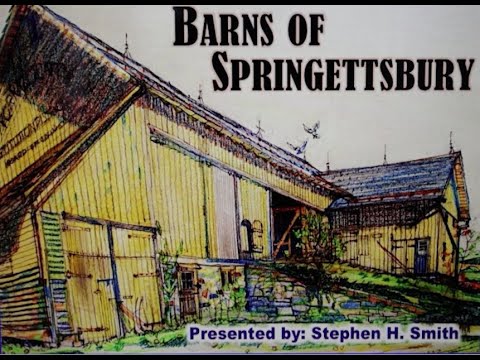
Stephen H. Smith, chairman of the Springettsbury Township Historic Preservation Committee, presented a History Night lecture that surveyed 10 historic barns across Springettsbury Township, outlining their construction, loss and reuse.
Smith said he would "be exploring the history, variation, and interesting stories of barns at 10 sites in the township," and used archival photos, county records and artwork to illustrate his talk. He told attendees the committee was established at the township centennial to identify historically significant structures and to document the township’s history.
The presentation opened with the Strickler Farmhouse barn (the Strickler Barn), which Smith located behind the York County Jail and tied to the Strickler family. Smith said the farmhouse’s original section dates to about 1740 and that a first part of the barn likely dates to the 1830s, with a Civil War–era addition. He said about 150 burials remain in the Strickler Miller Cemetery on the property.
Smith next described a county-owned barn built for the York County home (Pleasant Acres) in 1931. He said the county purchased nearby property during the 1930s and used the barn for farm production; later the site shifted to grounds maintenance for county properties and the barn continued in that role.
Several barns that once stood on Market Street and North Hills Road illustrated patterns of repurposing and loss. Smith described one Market Street barn that became York’s Garden Center at 2905 East Market Street and was later demolished to make way for commercial development. He described a stone barn along North Hills Road that was repeatedly repurposed (warehousing, contractor yards) and ultimately demolished amid safety concerns after stones fell onto the roadway and nearby road-widening and truck traffic compromised its west wall; Smith noted its timbers were salvaged for reuse.
A long-running local example of successful restoration was the former Etline barn and Victorian house at 3790 East Market Street. Paul and Dorothy Etline ran an antiques business there for decades; Smith said the property sold in 2013 and that public opposition helped dissuade a proposed demolition by a national retailer. After several years vacant, Maria and Greg Koller stabilized and restored the structure and reopened it as American Daydream Antiques and Miscellania on 06/01/2019, Smith said.
Smith covered the Meadowbrook/Avalon dairy barns tied to Harold Robertson and Robertson Farms: a major 07/07/1934 fire destroyed earlier barns, later rebuilds and a 10/31/1939 fire damaged upper sections (the stone lower floors survived). Smith traced later commercial uses of the south barn, including the False Grama factory outlet from roughly 1950 to 2008, and recounted subsequent vacancy and redevelopment proposals.
He also described two brick-end barns built by brothers Jacob and John Meyer in the early 19th century, noting the brick-end technique was costly and unusual locally and that the brothers’ barns shared distinctive decorative patterns. Smith explained why brick-end construction is rare (custom bricks made on-site) and said the barn timbers were often salvaged when structures were dismantled.
Smith highlighted a smaller, privately restored stone barn on Pleasant Valley Road that was repaired for use by a local landscaping business (TODS: Total Outdoor Design Solutions) after neighbors supported a variance to keep the business at that site.
Throughout the talk Smith emphasized a practical preservation point: barns that find ongoing commercial use or local stewardship are most likely to survive. He closed by noting that three of the 10 barns he discussed remain standing and thanking the audience. The event was recorded and will be posted on the township’s website, Smith said.
The Historic Preservation Committee’s talk provides a consolidated view of local agricultural architecture, the circumstances that lead to demolition (fires, road expansion, commercial redevelopment) and examples where community interest and private investment preserved structures. The committee said it will continue documenting other surviving barns in future History Nights.