
PPS graduation rate dips to 82.5% for Class of 2025; postsecondary readiness edges up to 71.7%
Get AI-powered insights, summaries, and transcripts
Subscribe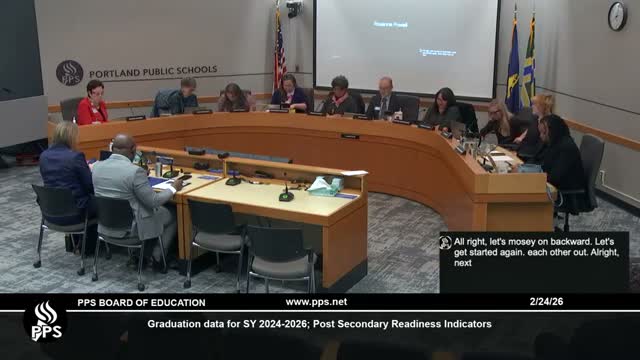
Summary
District data show a three-year decline in four-year graduation rates to 82.5% for the Class of 2025 while postsecondary readiness rose to 71.7%; staff proposed "Project Graduation" targeted supports and emphasized that time in the district strongly correlates with graduation outcomes.
District accountability leaders presented Class of 2025 outcomes to the board on Feb. 24, reporting a four-year cohort graduation rate of 82.5%, a 1.4-percentage-point decline from 2024 and the third consecutive year of decline. Renard Adams, the district's chief accountability and equity officer, said the metric is calculated using ninth-grade cohorts and cautioned that cohort accounting is more complex than a simple numerator/denominator calculation.
Adams and the academic team highlighted subgroup patterns: students with disabilities showed notable improvement (approaching 72% graduation rate), while declines among some racial and ethnic groups and English-language learners drove the overall drop. Staff emphasized that "time in the system" matters: students continuously enrolled in PPS high schools for four years have a much higher on-time graduation rate (about 96%) than students who transfer in later.
On postsecondary readiness, the district reported an increase to 71.7% of graduates demonstrating readiness through a variety of measures (AP/IB, dual-credit, successful completion of CTE pathways, Seal of Biliteracy, or benchmark scores on PSAT/SAT/ACT). Adams said nearly every racial and ethnic subgroup improved on postsecondary readiness metrics except Pacific Islander students whose measures remained flat.
Staff proposed "Project Graduation," a combined short- and long-term intervention that would coordinate targeted supports across central office and high school leadership, focus on ninth-grade on-track strategies, credit recovery, data systems, and sharing of best practices across campuses. Directors asked for additional breakdowns by school and subgroup, CTE participation analyses, and DLI program correlations; staff agreed to provide requested cross-tabulations and to share dashboards that permit further analysis.
Board members pressed on data quality and the effects of transfer students, and staff acknowledged some data-processing challenges this cycle related to central-office staffing changes; they said they will reconcile files and share school-level subgroup data on request.