
CRA recommends denial of Hobe Sound RV-park LDR amendment after staff warns of state preemption
Get AI-powered insights, summaries, and transcripts
Sign Up Free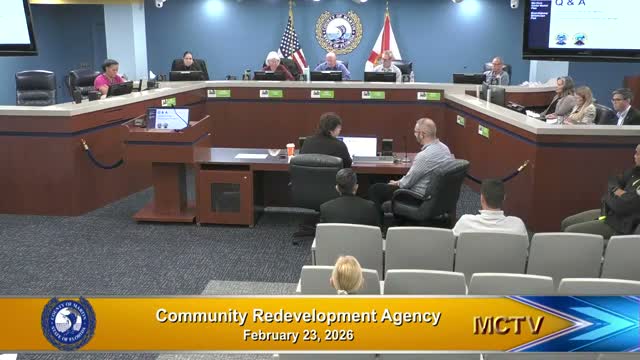
Summary
Martin County growth-management staff recommended denial and the CRA recommended denial of a proposed text amendment that would loosen RV park site-size and density standards in the Hobe Sound CRA; applicants argued relief is required to fund sewer upgrades and improvements.
The Martin County Community Redevelopment Agency on Feb. 23, 2026 recommended denial of a proposed text amendment to Article 12 of the county Land Development Regulations that would have changed recreational vehicle (RV) park standards in the Hobe Sound CRA.
Staff analysis: John Sennett, principal planner with Growth Management, told the CRA the applicant’s proposed language would reduce the minimum RV site size from 2,000 to 1,500 square feet, raise the maximum density from 10 to 15 sites per acre, permit accessory dwelling units as permanent structures, exempt managers/caretakers from short-term tenancy limits in certain circumstances, and remove the existing prohibition on park trailers. Sennett cautioned that state law and administrative rules could preempt the local changes, citing state regulations and the Florida statutes. "RV parks are subject to state regulations including Florida Administrative Code, Chapter 64E-15 and Chapter 513 Florida Statutes," Sennett said, and staff recommended denial based on those preemption risks and inconsistency with existing Martin County standards.
Applicant case: Attorney Krista Story, representing owners Suzanne and Michael Graham, and the Grahams themselves argued the change is a narrow, CRA-specific adjustment to make a long-standing, locally operated RV park financially viable. The applicants said the park is currently permitted by the health department for 88 sites and that upgrading sewer and other infrastructure could require an additional 17–27 sites to be economically feasible. Susie Graham told the CRA: "we anticipate the cost to be between anywhere between 50 to $90,000 per site to be able to build this." The Grahams said many existing sites are small and that the compromise language was intended to avoid the extremes of state standards while allowing modest reinvestment.
Community concerns: The Hope Sound Neighborhood Advisory Committee recommended denial (a close vote). Neighbors and NAC members raised two consistent objections: that the amendment might be used as a precedent elsewhere in other CRA areas, and that the county could lose local control if state rules on lot size and density were triggered. A public commenter summarized the local worry: approving local changes could "open up Hope Sound to a problem" if less restrictive standards applied more widely.
Board action: After discussion a motion was made to "approve staff’s recommendation of denial" and was seconded. The CRA recorded the board’s motion in favor of denial and moved the recommendation forward; the transcript records the final tally as in favor of denial.
What it means: The CRA’s recommendation is advisory; the text amendment must still be considered by the local planning agency and the Board of County Commissioners. Staff and the NAC flagged two policy tensions: whether parcel- or CRA-limited relief is legally viable, and the balance between preserving neighborhood character and enabling reinvestment in an existing local business.
Next steps: The applicants may pursue their application before the local planning agency and the Board of County Commissioners; staff will continue to advise on legal preemption and on whether a parcel‑specific alternative is feasible.