
Commission sends staff to meet with Chancey Bay Ranch and FDACS, orders research after Guardians warn of water‑quality risks
Get AI-powered insights, summaries, and transcripts
Subscribe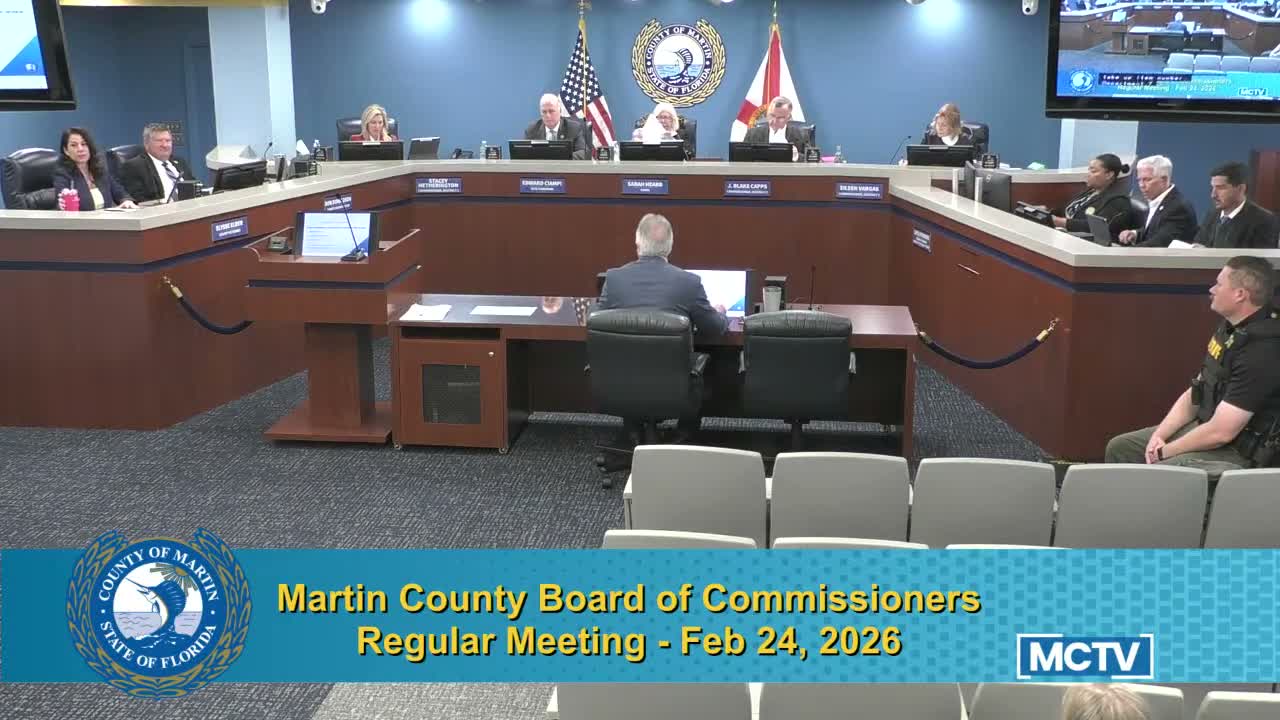
Summary
Following public testimony from the Guardians of Martin County highlighting potential water‑quality, wetlands and endangered‑species risks and questioning FDACS’ determination, the board unanimously directed staff to request an informal meeting with the property owner and FDACS and asked county legal staff to research statutory and case law options.
Martin County commissioners unanimously approved a two‑step approach to the proposed Chancey Bay Ranch meat‑processing facility: (1) dispatch a small staff team (growth management, environmental engineering and other appropriate staff) to request an informal meeting with the property owner and Florida Department of Agriculture and Consumer Services (FDACS) to seek additional information, and (2) direct county legal staff to research relevant statutory and case law in the event legal review is necessary.
Peter Walden, deputy growth management director, told the board the facility had entered county review as a major final site plan for a 56,000‑square‑foot building on 26 acres of the ranch and that the county’s development review stopped after FDACS general counsel concluded some elements qualified as bonafide agricultural use; the applicant then withdrew the county application and pursued state permitting pathways. Walden noted the county’s map, zoning, and the site’s proximity to Lake Okeechobee.
Greg Braun, Executive Director of the Guardians of Martin County and a professional ecologist, told the board the project ‘‘appears to be moving forward without any environmental controls’’ and expressed urgent concerns about water withdrawals, land‑application of wastewater or effluent, fertilizer and nutrient loads, wetlands, and the potential effects on Lake Okeechobee and the Rim Canal. Braun also cited Florida Statutes section 193.461 (property appraisal definitions) and argued the proposed operation—because it would accept animals from beyond the ranch—may be an industrial processing use rather than a purely agricultural activity.
Commissioners debated next steps. Many cautioned a heavily adversarial posture could reduce cooperation; several supported a diplomatic outreach first. Commissioner Capps proposed independent legal review and involvement of the Guardians in selecting outside counsel; commissioners refined that to start with outreach and staff fact‑finding and then pursue outside counsel if unresolved. The motion the board adopted directs staff to attempt an informal informational meeting with FDACS and the property owner and asks county legal staff to research statutory and case law; the Guardians indicated willingness to support and to consider funding outside counsel if needed.
What happens next: County staff will attempt the informal outreach to the property owner and FDACS and return to the board with factual findings; county legal staff will perform in‑house research on the Right to Farm Act and related authority and report back with options.