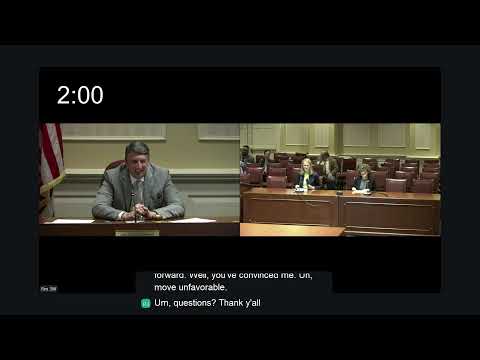
Administration asks Budget & Taxation Committee to back DECADE Act to sharpen economic development tools
Loading...
Summary
Administration officials and business groups urged the Budget and Taxation Committee to give a favorable report to SB 388 (DECADE Act of 2026), saying it streamlines economic development tools, extends key tax credits and shifts some funds to improve business attraction. Witnesses cited recent large private investments and proposed targeted funding for commercialization projects.
The administration asked the Budget and Taxation Committee on the record to report favorably on Senate Bill 388, the Delivering Economic Competitive and Advancing Development Efforts (DECADE) Act of 2026, framing the measure as a targeted way to sharpen the state’s economic-development toolbox.
Tony Bridges, deputy legislative officer for Governor Wes Moore, told the committee the bill aims to improve program clarity and coordination, noting the administration’s budget request includes capital and program funding tied to the measure. Harry Coker, Maryland’s secretary of commerce, described provisions that would move the Sunny Day Fund (Economic Development Opportunities Program Fund) into Commerce as a Strategic Closing Fund focused on attraction rather than retention, extend select tax-credit sunsets (research-and-development credit through 2031 and employer security-clearance-cost credit through 2032), and remove the $10 million per-production cap on the film production tax credit to allow larger projects to qualify.
Tom Sadowski, executive director of the Maryland Economic Development Corporation (MEDCO), and business groups including the Greater Baltimore Committee said the bill is more narrowly focused this year — roughly 10 provisions — and is designed to increase private investment and job creation. Sadowski said MEDCO will manage the innovation infrastructure grant program and the rise-zone program after program transfers contemplated by the bill.
Committee members asked about specific revenue shifts and program mechanics. Witnesses explained one change would reallocate a portion of Video Lottery Terminal (VLT) revenue: splitting the current 1.5% contribution to the Small, Minority and Women-Owned Business Account (SMOWBA) to 0.75% (about $10 million) for SMOWBA and 0.75% for the Maryland Small, Minority, and Disadvantaged Financing Authority (MSPDFA). Advocates said the change replaces existing special-fund and general-fund appropriations with the VLT stream to provide predictable, sustainable revenue for MSPDFA lending programs.
Panelists also acknowledged shortcomings with the Rhizome/rise‑zone program’s prior outcomes and said moving administration and financing authority to MEDCO would enable administrative and financing changes (including longer bond terms and flexible lease structures) intended to make projects — for example, lab or innovation space near universities, hospitals, and military installations — economically feasible and more attractive to developers. A range of supporters, including film industry advocates and beneficiaries of small-business programs, gave examples of past investments and urged continued support.
The panel repeatedly asked the committee for a favorable report and signaled willingness to work in follow-up work groups on implementation details and targeted amendments. The committee chair noted work groups would be convened to refine technical provisions and listen to stakeholder concerns. The hearing did not record a formal vote on the bill; sponsors asked the committee to move forward with further drafting and stakeholder engagement as needed.